
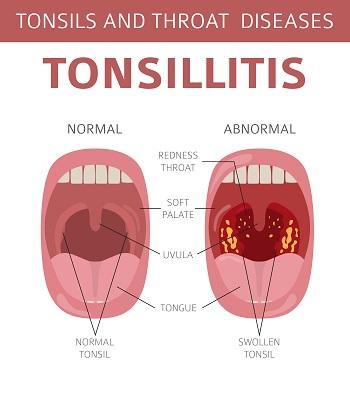
Inside our mouths are two oval-shaped pads of tissue at the back of the throat called tonsils. The swelling in the tonsils is called tonsillitis. Due to tonsillitis, the victim may face a sore throat, difficulty in swallowing, soft lymph nodes on the sides of the neck, and problems in speaking often.
Most cases of tonsillitis are caused by infection with a common virus, but bacterial infection can also cause tonsillitis. Tonsillitis is usually caused by streptococcal bacteria, which causes strep throat (a bacterial infection that causes swelling and pain in the throat). Tonsillitis caused by strep throat can cause serious complications if left untreated. Since appropriate treatment for tonsillitis depends on the cause, it is important to get a prompt and accurate diagnosis. Surgery can be done to remove the tonsils, which is done when this problem starts happening again and again and the person has to face many complications due to it.
How Many Types Of Tonsils Are There?
People who suffer from tonsillitis know very well about its severity. Rest, you can guess about its seriousness from the fact that there are six types of it. All six types of tonsillitis are described below: –
1. Acute tonsillitis Acute tonsillitis:- In this stage of tonsillitis a bacterium or virus infects the tonsils, causing inflammation and sore throat. In this type the tonsils can develop a gray or white coating. Acute tonsillitis occurs suddenly and does not last long.
2. Chronic tonsillitis: If a person is having tonsillitis frequently, then he is classified as having chronic tonsillitis. Sometimes recurrent episodes of acute tonsillitis result in chronic tonsillitis.
3. Peritonsillar abscess Peritonsillar abscess: – This type of tonsillitis involves pus accumulating around the tonsils that have been infected, which pushes it in the opposite direction. Peritonsillar boils should be dried immediately. The type of tonsillitis is considered quite serious.
4. Acute mononucleosis: The type of acute mononucleosis is usually caused by contracting the Epstein-Barr virus. ‘Mono’ can cause severe swelling, fever, sore throat, rash, and fatigue in the tonsils.
5. Strep throat: The strep throat type of tonsillitis is caused by a bacterium called “streptococcus.” In this, not only the tonsils but also the throat gets infected very seriously. Sore throat is often accompanied by fever and neck pain.
6. Tonsilloliths, or tonsil stones Tonsilloliths or Tonsil Stones: – Tonsil stones, or tonsilloliths, a type of tonsillitis, occur to a person when waste is stuck in the throat and becomes hard.
What Symptoms Appear When Tonsillitis Occurs?
The problem of tonsillitis can happen at any time. But this problem occurs mainly during adolescence and mid-teens. When a person has tonsillitis, the following symptoms appear: –
1. Swollen tonsils
2. Redness of tonsils
3. White or yellow coating or spots on the tonsils
4. Sore throat
5. Difficulty or pain in swallowing
6. Difficulty speaking when a serious condition occurs
7. Having a fever (sometimes tonsils also swell due to fever)
8. Enlarged, tender glands (lymph nodes) in the neck
9. A hoarse, muffled, or throaty sound
10. Bad breath
11. Having a stomach ache
12. Neck pain
13. Stiffness in the neck
14. Headache problem (it can range from normal to severe)
Young children who have not yet started speaking may also have tonsillitis. Symptoms of tonsillitis in young children can be identified as the following: –
1. Salivation due to difficult or painful swallowing
2. Refusal to eat
3. Unusual rashness
When Should I See A Doctor If My Child Has Tonsillitis?
If your child has symptoms that may indicate tonsillitis, it is important to get an accurate diagnosis. During this time, if you notice the following problems along with the abovementioned symptoms in your child, then you should contact the doctor as soon as possible: –
1. Sore throat with fever
2. Sore throat that does not go away within 24 to 48 hours
3. Painful or difficult to swallow
4. Excessive weakness, fatigue, or fussiness
Along with the above symptoms, if your child or an adult starts having the following problems due to tonsillitis, then in case of emergency, you should consult a doctor: –
1. Difficulty in breathing
2. Extreme difficulty swallowing
3. Excessive drooling (excessive drooling)
What Causes Tonsillitis?
Tonsil is your first line of defense against disease. V: Produce white blood cells that help your body fight infections.
Tonsils fight bacteria and viruses that enter your body through your mouth and nose. However, tonsils are also vulnerable to infection from pathogens that they help keep away. In simple words, the problem of tonsillitis occurs in a person by fighting the virus and providing protection to the body.
A virus, such as the common cold, can trigger tonsillitis. Bacterial infections, such as strep throat, are also possible causes.
What Are The Risk Factors For Tonsillitis?
There are not many risk factors for tonsillitis; there are only two following risk factors:
1. Young age: Tonsillitis most often affects children, and tonsillitis caused by bacteria is most common in children aged 5 to 15 years.
2. Repeated exposure to germs Freequent exposure to germs: – School-age children are in close contact with their peers and are often exposed to viruses or bacteria that can cause tonsillitis.
What Complications Can Arise From Tonsillitis?
If a person is having tonsillitis frequently, it can cause inflammation of the tonsils and complications associated with inflammation, the main ones being the following: –
1. Interrupted breathing during sleep (obstructive sleep apnea)
2. Infection that spreads deep into the surrounding tissue (tonsillar cellulitis)
3. Infection resulting in accumulation of pus behind the tonsils (peritonsillar abscess)
Tonsillitis Vs. Strep Throat
Tonsillitis and strep throat can result from the same bacteria in some cases, but it is not the same.
Many different bacteria or viruses, including Group A Streptococcus bacteria (A Streptococcus bacterea), can cause tonsillitis. This bacteria is the only cause of strep throat. Both conditions are contagious, so you should try to stay away from other people if you feel you are struggling with either of these problems.
If tonsillitis caused by Group A streptococcus or another strain of streptococcal bacteria is not treated or if antibiotic treatment is incomplete, your child is at increased risk for rare disorders such as:
1. Rheumatic fever, a serious inflammatory condition that can affect the heart, joints, nervous system, and skin
2. Complications of scarlet fever, a streptococcal infection characterized by a major rash
3. Inflammation of the kidney (poststreptococcal glomerulonephritis)
4. Poststreptococcal reactive arthritis, a condition that causes inflammation of the joints.
How Is Tonsillitis Examined?
If you think that your child has tonsillitis, the doctor will first identify the symptoms and also do the following physical examination:
1. Checking for a rash known as scarletina, which is associated with some cases of strep throat.
2. Feeling your baby’s neck gently (beating) to check for swollen glands (lymph nodes).
3. Listening to his breathing with a stethoscope.
4. Checking for spleen enlargement (to consider mononucleosis, which also inflates the tonsils).
Throat Phlegm Throat Swab
With this simple test, the doctor rubs a sterile swab (sterile swab) on the back of your child’s throat to get a sample of the secretion. The sample shall be checked in a clinic or laboratory for streptococcal bacteria.
If the rapid in-clinic test comes back positive, your child almost certainly has a bacterial infection. If the test comes back negative, your child is likely to get a viral infection. Your doctor, however, will wait for a more reliable out-of-clinic lab test to determine the cause of the infection.
Complete Blood Cell Count (CBC)
Your doctor may order a complete blood cell count (CBC) with a small sample of your child’s blood. The result of this test, which can often be completed in a clinic, counts different types of blood cells. Complete information is available about what is increased in the body and what is at a low level, and this provides information about whether the infection is more likely to be caused by a bacterial or viral agent. A CBC is often not required to diagnose strep throat. However, if the strep throat lab test is negative, a CBC may be needed to help determine the cause of tonsillitis.
How Is Tonsillitis Treated?
A mild case of tonsillitis does not require treatment, especially if it is caused by a virus, such as a cold. Treatment for more severe cases of tonsillitis may include antibiotics or tonsillectomy. If a person experiences dehydration due to tonsillitis, they may also need intravenous fluids. Pain medications to relieve sore throat can also help the throat heal. If the problem increases, then according to the current situation, this problem can be treated in the ways mentioned below: –
Antibiotics, Antibiotics
If tonsillitis is caused by a bacterial infection, your doctor will advise you to take antibiotics. Penicillin group A taken by mouth for 10 days is the most common antibiotic treatment prescribed for tonsillitis caused by streptococcus. If your child is allergic to penicillin, your doctor may prescribe an alternative antibiotic.
Your child should take the full course of prescribed antibiotics, even if the symptoms go away completely. Failure to take all medications as directed may result in worsening of the infection or spread to other parts of the body. Not completing a full course of antibiotics may, in particular, increase your child’s risk of rheumatic fever (rheumatic fever) and severe kidney inflammation.
Surgical Surgery
Surgery to remove the tonsils (tonsilectomy) can be used to treat recurrent tonsillitis, chronic tonsillitis, or bacterial tonsillitis that cannot be cured with antibiotic treatment. Recurrent tonsillitis is usually defined as the following:
1. Occurring at least seven times or more in the previous year
2. To be at least five times or more in a year in the last two years.
3. To be at least three times or more in a year in the last three years.
If a person is facing many serious conditions due to tonsillitis and is facing other complications (mentioned above), then tonsillectomy can also be done. Tonsillectomy is surgery for tonsillitis that is performed during the following conditions:
1. Obstructive sleep
2. Difficulty breathing
3. Difficulty swallowing (especially meats and other chunky foods)
4. An abscess that does not improve with antibiotic treatment
A tonsillectomy is usually performed as an outpatient procedure, unless your child is very young, has a complex medical condition, or complications arise during surgery. This means that your child should be able to go home on the day of surgery. A full recovery usually takes seven to 14 days.
Home Remedies For Tonsillitis
Whether tonsillitis is caused by a viral or bacterial infection, home care strategies can make your child more comfortable and recover much sooner. If a virus is the expected cause of tonsillitis, the following strategies are the only treatments. Your doctor will not recommend taking antibiotics. Your child will recover in seven to 10 days. Home care strategies used during recovery time include the following: –
1. Encourage rest. Encourage rest: – Encourage your child to get plenty of sleep.
2. Provide adequate fluids. Provide comforting foods and beverages: – Give your child plenty of water to keep his throat moist and prevent dehydration.
3. Provide comfort food and beverages. Hot liquids—hot water with broth, caffeine-free tea, or honey—and cold treatments like ice pops can soothe sore throats.
4. Gargle with salt water. Prepare a saltwater gargle: – If your child can gargle, gargling with salt water by mixing 1/2 teaspoon (2.5 ml) of table salt with 8 ounces (237 ml) of warm water can relieve a sore throat. Ask your child to gargle with the solution and then spit it out.
5. Moisten the air. Humidify the air: – Use a cold air humidifier to eliminate dry air that may further aggravate a sore throat, or ask to sit for several minutes in a steamy bathroom with your child.
6. Lozeng Dena Office lozenges: – Children over 4 years old can suck lozenges to relieve sore throats.
7. Prevent irritation: Avoid irritants—Keep your home free of cigarette smoke and cleaning products that can irritate the throat.
8. Treat pain and fever. Treat pain and fever: – Talk to your doctor about using ibuprofen (Advil, Children’s Motrin, among others) or acetaminophen (Tylenol, among others) to reduce throat pain and control fever. Low fever without pain does not require treatment.
Children and adolescents should not take aspirin unless prescribed by a doctor to treat a particular disease. Children’s use of aspirin to treat symptoms of illnesses such as colds or flu has been linked to Reye syndrome, a rare but potentially life-threatening condition.
Is Tonsillitis Contagious?
Tonsillitis is not contagious, but the infectious organisms it causes can reach other people for 24 to 48 hours before developing any symptoms. It can spread to others unless you are sick. After about 24 hours of taking antibiotics, bacteria or viruses will no longer be able to reach other people.
If you already have someone who struggles with tonsillitis contagion, coughing, or sneezing, and you breathe in drops, you may develop tonsillitis. If you touch an object that contains potentially infectious organisms, such as a doorknob, and then touch your nose or mouth, you may also get tonsillitis.
Being in contact with a lot of people increases the risk of exposure to bacteria and viruses that cause tonsillitis. This is why school children often get this disease. If you have symptoms, it is best to stay at home to avoid spreading tonsillitis.
It usually takes 2 to 4 days for symptoms to develop after exposure. Find out how to reduce your risk of getting or spreading tonsillitis.
Why Is Tonsillitis Painful?
We all know that tonsillitis is a painful problem, but now the question is, why does it hurt? So the following are some of the reasons mentioned due to which the patient experiences normal to severe pain when he has tonsillitis: –
1. When tonsils grow due to swelling, they cause pain.
2. In case of tonsillitis, there is a sore throat that causes pain.
3. Due to swelling in the tonsils, there is difficulty in swallowing anything, which causes pain.
4. White spots appear on the tonsil areas, which cause problems.
5. The patient has a fever greater than 100 degrees Celsius, which causes a lot of fatigue.
6. Stomach pain and vomiting problems.
How Long Does The Problem Of Tonsillitis Last?
How long tonsillitis will last and how much problem it will cause depends on which type of tonsillitis the person has suffered from. A person is susceptible to six types of tonsillitis. Tonsillitis can last for the following days depending on its type:-
1. Acute tonsillitis: – Symptoms last just 3 to 4 days when acute tonsillitis occurs. If the problem becomes severe, symptoms may last for a maximum of 2 weeks.
2. Recurrent tonsillitis: – Tonsillitis This type can bother the patient several times a year, and its symptoms can last up to two weeks.
3. Chronic tonsillitis:- Chronic tonsillitis occurs when a person has been suffering from tonsil infection for a long time.
What To Eat And What Not To Eat When You Have Tonsillitis?
If you or your child is suffering from tonsillitis, then first of all you have to keep in mind that during this time it is very difficult to swallow anything due to swelling in the throat; hence, you should take only such food that can be swallowed easily. Can go and it also gives strength to the body.
In case of tonsillitis, you should take the food mentioned below: –
1. Hot rice
2. Porridge
3. Semolina simile
4. Ginger
5. Honey
6. Boiled spinach
7. Boiled potatoes
8. Idli
9. Milk
10. Lukewarm water
11. Boiled egg or omelette
In case of tonsillitis, you should stay away from the food products mentioned below: –
1. Sour things—including vegetables, fruits, chutneys, and pickles.
2. Curd and buttermilk
3. Curry
4. All pickled vegetables and other diets
5. Fried foods
6. Meat—that is made with more oil, is spicy, and is roasted.
7. All types of sauce
8. Caffeinated diet
9. All types of canned food
10. Frozen diet
Disclaimer
This content, including advice, only provides general information. It’s by no means a substitute for qualified medical opinions. Always consult a specialist or your physician for more information. We does not claim responsibility for this information.)
Read Also:
- Symptoms, Causes, And Treatment Of Tonsil Stones
- What Is The Treatment For Throat Stones? Know The Symptoms, Causes, Prevention, And Treatment Of Tonsil Stones
- How To Treat Tonsil Stones At Home? Learn From An Ayurvedic Doctor
- Tonsil Stones: Causes, Symptoms, And Treatment Options
- How Does Blue Light Coming Out Of The Screen Affect The Eyes
- How Much Harm Does Screen Blue Light Cause To Your Eyes? Know From The Doctor
- Blue Light And Its Effects
- Excessive Screen Time Can Be Responsible For Increasing The Number Of Glasses. Know Its Risks From An Ophthalmologist
- Can Seeing Too Many Screens Cause Glasses To Appear On The Eyes? Learn From Experts
- The Digital Age And Excessive Screen Time: Effects On Health
- If You Spend Hours On Mobile And Laptop, Then Know Its Effects: Not Only The Eyes But Also The Skin Gets Harmed
- Careful! Drinking Too Much Cold Drink Can Be Dangerous; It Has A Bad Effect On These Organs
- Do You Also Drink Cold Drinks To Cool The Body? This Habit May Become Fatal
- Drink These 7 Natural Drinks Instead Of Coffee For Better Energy
- Are You Keeping These Types Of Food In Plastic Boxes? Change Your Habits Immediately; Otherwise, Your Health May Gradually Get Dangerous Effects
- The Hidden Truth Behind Your Soft Drink: Revealing The Dangerous Things Present In Soda
- Big Benefits Of Drinking Water
- Importance Of Water