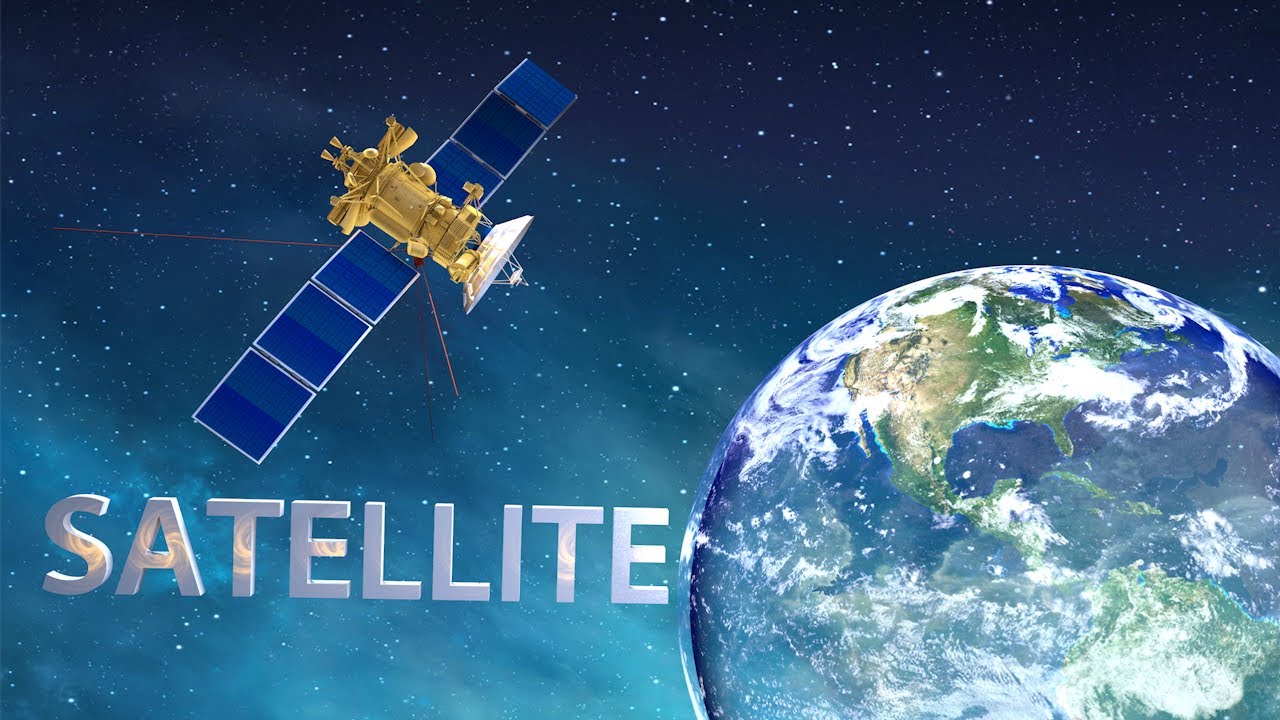



You must’ve heard about satellite. TV news often hears about satellite launches, which are launched by various space agencies such as NASA or ISRO. During that time, these questions must have come in your mind that what are these satellites and how do they fly in space and what is their function?
In this article you will be given complete information about what satellite is, how satellite works, types of satellite etc. So let’s move ahead without any delay and know the complete information related to satellite.
What Is Satellite
Satellite is an object in space that orbits around a planet or star. Satellites (satellites) can be natural as well as artificial (manmade or artificial). Like the moon orbits around the earth so it’s the earth’s satellite, and the earth orbits the sun so it’s the sun’s satellite. Similarly International Space Station (ISS) is an artificial satellite that orbits Earth.
Our solar system has dozens of natural satellites orbiting a planet. Wherein there are tens of thousands of artificial satellites that orbit the Earth. Some satellites keep taking photos of Earth, keeping meteorologists informed about weather. While some satellites keep taking photos of other planets, the Sun, Black Holes and distant galaxies. These photos help scientists better understand solar system and universe.
Other satellites are primarily used for communication, such as sending tv signals and phone calls around the world. Simultaneously there’s a bunch of more than 20 satellites used to prepare Global Positioning System (GPS). Satellites can pinpoint your exact location with GPS.
How Does Satellite Work?
As we know satellite is a self-contained communication system that receives signal from Earth and sends signal back to Earth in response. A satellite is designed to tolerate the hostile environment of space during its fixed operational life, where it can encounter radiation and extreme temperatures. Satellite should be light with that. Because launching expenses depend on satellite’s weight alone. Satellite must therefore be made of light and strong metal to deal with all these difficulties. Satellite is unlikely to be maintained or repaired (maintenance) in space, so it’s necessary to operate at reliability greater than 99.9%.
Satellite’s parts may vary depending on its function, but some components are found to be common to almost all satellites:
- Antenna: Antenna system used to receive and transmit signal back from Earth.
- Command and Data Handling: This we could call Satellite’s operational heart. Command and control systems monitor every aspect of the satellite and receive command from Earth for operation.
- Guidance and Stabilization: Sensors in satellite monitor satellite’s location in room and make sure it’s headed in the right direction. Thrusters and other tools adjust direction and location of satellite when needed.
- Housing: It’s made from strong metal to tolerate the hostile environment of space and work without damage.
- Power: Most satellites convert sun rays into electricity using solar panels.
- Transponders: Uplink and downlink signals come and go on separate frequencies. Transponders translate uplinked frequencies (frequencies) into downlink frequencies and then amplify to send the converted transmission to Earth.
- Payload: Payload is used to gather information, such as camera or particle detector.
Why Is Satellites So Important?
Satellites can see large areas of Earth or another planet at once like a bird. That means satellites can collect more and instant data instead of Earth-bound devices. Space better seen through satellite than any telescope seen from Earth. Because satellites fly above clouds and atmosphere-bound dust and molecules, which form obstacles when viewed from Earth.
Signals weren’t possible to send far before satellite arrived. Because TV signals could only travel in a straight line. So these signals faded into space, rather than following Earth’s curve (curve). Plus sometimes mountains and tall buildings blocked these. Phone calls also had trouble in distant areas. Laying telephone wires over long distances and underwater was difficult and expensive. Now with satellite Tv signals and phone calls are sent up to satellite and then at about the same time satellite can send these signals to different places on Earth.
How Does Satellite Survive In Space?
Mostly satellites are launched into space via rocket. Satellite orbits Earth only when its speed is balanced by Earth’s gravitational pull. Without this balance satellite can fly in a straight line in space. Satellites orbit Earth at different heights, speeds and paths.
Mainly satellites orbit in these three orbits which are as follows:
- Low-Earth Orbit: It extends from orbit surface to altitudes of 160 to 2000 kilometers. This orbit alone mostly completes human missions that don’t belong to other planets. Also International Space Station orbits in this orbit.
- Geostationary Orbit: This is the area with an elevation 35,786 km above Earth’s equator (equator). Perfect location for communication satellite use. Satellites travel west to east in this orbit. It rotates with the same direction and speed as the Earth rotates. Geostationary satellites always appear in the same place when viewed from Earth, because they exist in the same place above Earth.
- Polar Orbit: Polar Orbit low earth orbit has a subtype itself with elevations between 200 and 1000 kilometers above the Earth’s plane. Satellites in this orbit travel pole to pole (pole-to-pole) north south. For example weather satellites and satellites used for military testing.
How Many Types Are There Artifical Or Man Made Satellites?
There are mainly two types of satellites: natural and artificial satellites. But talk about artificial satellites (artifical or manmade), there are 11 types which are as follows:
- Astronomic Satellites: These are satellites used to study distant planets, the universe and other outer space objects.
- Bio Satellites: These are satellites used to transport living organisms into space. Usually used for scientific experiments.
- Communication Satellites: These satellites are used for telecommunication purposes. Modern communication satellites typically use geostationary or geosynchronous orbit, molniya orbit or low-earth orbit.
- Navigation Satellites: These satellites use radio time signals transmitted over enabled mobile receivers to find their exact location on the ground. For example Global Positioning System (GPS).
- Weather Satellites: They’re used to monitor weather and climate on Earth.
- Earth Observation Satellites: They’re used to map, monitor the environment and get meteorological information.
- Killer Satellites: These are satellites used to destroy enemy weapons, satellites and other space assets.
- Craved Speccraft: These are also called specships. These are big satellites capable of leaving human or beyond and bringing them back. They have major landing facilities and are used to get to and from an orbital station.
- Miniaturized Station: These satellites are smaller in size and underweight. By weight they are classified into three parts: minisatellite (500-1000 Kg), microsatellite (less than 100 Kg) and nanosatellite (less than 10 Kg).
- Space Based Solar Power Satellites: These are satellites used to take energy from sunlight and transmit it for use on Earth or anywhere else.
- Space stations: These are artificial orbital structures that are constructed for humans to stay in outer space. Space stations are designed to stay in orbit (orbit) for periods of days, weeks, months or years.
Where Are Satellites Used?
Satellites are used for the following tasks:
- Satellites used to transmit tv signals. Without satellite TV signals can travel in the same direction and be obstructed by buildings and trees.
- Satellite also used for mobile communication. Places where is not possible to reach can easily send phone signals via satellites.
- Satellites used for Navigation. For example Global Positioning System (GPS). Used to find mobile phones and car locations.
- Meteorologists use satellites to detect weather. Which gives them information about natural disasters like rain, storms, etc. in advance.
- Satellites used to monitor climate and environment. Seas, glaciers, etc. can be monitored with the help of these satellites. Additionally, through satellite, scientists can determine long-term patterns of rainfall, vegetation cover and greenhouse emissions.
- Sea and wind waves can be watched via Earth Observation Satellites. Also wildfires, oil spills and airborne pollution can be traced.
- Satellite could also be used for military operations that can monitor every enemy activity and locate their military bases.
- Satellite used to explore distant planet, universe or other space-related things.
- Underground water and mineral sources can be detected through satellites. Simultaneously massively dispersed infrastructure can be monitored, like oil pipelines that have leak detection.
How Is One Satellite (Satellite) Prevented From Colliding With Another Satellite?
Earth orbit holds nearly 5 million artificial satellites orbiting Earth. These only have a few satellites that’s worth using. That means there’s a lot of junk floating in space too. So collision risk increases greatly whenever a satellite is left in class (orbit). Space agencies first ponder over orbital path whenever they launch something into space. Some agencies, such as United State Space Surface Network, monitor orbital waste from Earth. Alerts space agencies if stray piece threatens to hit a must.
What Is Satellite Phone?
Satellite phone is phone that satellites are used to connect to another phone or telephone network. That means cell sites on Earth aren’t used for it. Its biggest advantage is that it has no limited scope and can be used anywhere on Earth. Signal comes out of satellite phone and goes to satellite while satellite phone is in use. This signal’s then sent back to another phone on Earth.
Conclusion
I hope you like this article of mine “What is Satellite and how does it work?” Must’ve liked. I’ve tried my best to simply explain every information about Satellite so you don’t need to visit another website regarding this topic. If you liked this information or learned something new, please share it on other social media networks like WhatsApp, Facebook, telegram, etc.
Read Also:
- Disadvantages Of Technology
- Technology – Advantages And Disadvantages Of Technology
- Importance Of Technology
- Important Information About Technology
- This Technology Will Instantly Identify Heart Diseases
- Advanced Military Technology In Russia
- Artificial Intelligence (AI) And Technology In Health Care: Overview And Possible Legal Implications
- Green Artificial Intelligence(AI) Technology In Various Sectors
- Using Green Artificial Intelligence (AI) Technology In Fintech
- Negative And Positive Impacts Of Using Artificial Intelligence (AI) In The Information Technology Sector
- Key Challenges Of 6G Technology
- Wi Fi Offloading Technology Overview And Approaches
- Development Of 5G Technology