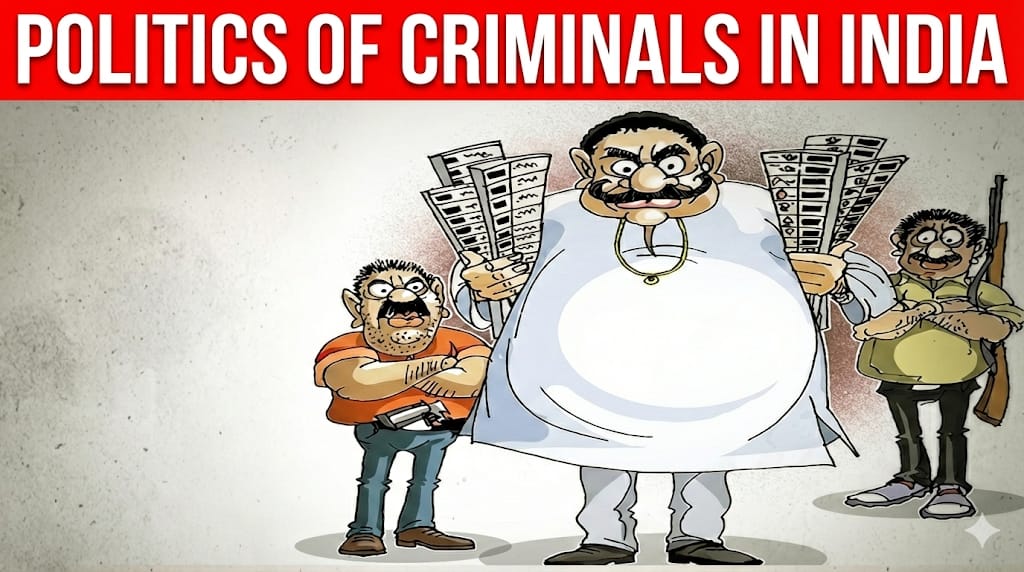



Today’s Indian politics is often described by many citizens as the politics of criminals, as a large number of political leaders are questioned, accused, or involved in serious criminal cases such as kidnapping, rape, murder, corruption, and abuse of power. This comes not only from the courts but also from people’s experience, repeated news, social discussions, and long-term observation of how power and crime work together in the political system. When people see people with such allegations holding powerful positions like MLA, MP, Chief Minister, Home Minister, and even Prime Minister, people’s faith in democracy is badly broken.
In a healthy democracy, politics means public service, moral leadership, and making laws for the welfare of citizens. But, when politics becomes dominated by people who are repeatedly accused of serious crimes, it starts to look more like a security system for power and wrongdoing than a service.
Many people feel that politics is no longer about solving problems like poverty, unemployment, education, healthcare, and security, but about controlling institutions, impunity, and maintaining influence. This belief is further strengthened when accused leaders remain in office without timely accountability.
A major reason for this thinking is the slow justice system. Criminal cases against powerful politicians often drag on for years without any results. During this long period, accused leaders contest elections, become ministers, and influence the administration. This makes common citizens realize that the law is not equal for everyone. A poor man can be arrested quickly, while a powerful politician enjoys protection, delay, and influence. This unequal experience of justice seriously damages public trust.
Another reason to consider today’s politics as criminal is the misuse of power and institutions. The police, investigative agencies, and administrative systems are often considered to be working under political pressure. When law enforcement agencies discriminate—causing harsh action against some and silently ignoring others—people conclude that power, not truth, determines who is innocent. This belief makes citizens feel unsafe and without protection.
When there is a lack of moral responsibility at the top level, people’s trust also diminishes. When leaders do not explicitly condemn violence, crimes against women, or abuses of authority, silence is considered support. The general public then feels that the criminals are being promoted, while the victims are being ignored. Over time, fear replaces trust, and silence replaces participation.
In this environment, democracy still exists in form—elections, speeches, slogans—but its spirit becomes weak. Voting starts to feel like choosing between power groups rather than choosing moral leadership. Citizens begin to feel that politics has become a place where crime, money, fear, and influence matter more than honesty and justice.
Therefore, the fact that today’s Indian politics is called the politics of criminals is not a legal decision but a social definition made up of repeated allegations, blatant abuse of power, weak accountability, and unequal justice. This deep thinking damages public trust, undermines democratic confidence, and creates fear, despair, and moral confusion in society.
1. Criminal Backgrounds Becoming Common in Elections
In today’s Indian politics, the idea of contesting elections with a criminal background has gradually become socially and politically “normal.” This didn’t happen overnight. From the late 1980s and early 1990s, when money and muscle power began to increasingly dominate elections in many states, political parties began fielding candidates who could “manage” voters through fear, influence, or money. There are several well-known cases where major national and regional parties have openly fielded candidates facing charges of kidnapping, murder, attempted murder, rape, land grabbing, and extortion. It was often argued that “the cases are political” or “the guilty have not yet been proven.” Over time, this excuse became common. For example, many MPs and MLAs elected after 2000 had serious criminal cases pending against them for years, yet they continued to win elections again and again. People’s perception that almost 95% of politicians are criminals does not mean that all are legally guilty, but it shows people’s deep frustration that people accused of serious crimes still dominate the legislatures. When assemblies and Parliament consist of people accused of killing rivals, running local mafias, or controlling illegal businesses, politics does not look like public service. Instead, it looks like a safe haven where criminals enjoy respect, protection, and power. This generalization sends a dangerous message to society: crime does not end political careers; sometimes it makes them. By looking at this history, youth learn that violence and fear can be shortcuts to success. Democracy then loses its moral foundation, as elections become less about values and more about who has the strongest criminal support.
2. Power Protects Criminals Instead of Punishing Them
A major reason for considering today’s Indian politics as criminal is how the political power protects the accused leaders from punishment. There are many examples in Indian history where leaders became more powerful after cases were registered against them. Once such a person becomes an MLA, MP, chief minister, or home minister, the entire system around him changes. Police officers investigating their cases are transferred, suspended, or pressured. The witnesses turn hostile out of fear. Files move slowly or disappear. This pattern has been visible since the 1990s, when coalition politics increased the bargaining power of the strongmen. For example, many ministers remained in office despite facing serious allegations because their support was needed to keep governments stable. In many states, the home departments themselves were under the control of politicians accused in violent cases, leading to a clear conflict of interest. When the same authority controls police postings and investigations, justice is weakened. People remember how cases of encounters, riots, and custodial violence were often stopped when influential leaders were involved. Even when courts ordered investigations, delays and non-cooperation undermined their impact. Over the decades, this has led to the belief that political power is not about upholding the law but about avoiding it. Ordinary citizens feel that the law is strictly applied to the poor, while the powerful get exemptions. That is why people say that criminals are ruling criminals. Uniforms of authority replace handcuffs, and power becomes a shield against accountability, reducing trust in democracy and governance.
3. Those Who Make Laws Are Breaking The Laws
Indian politics appears criminal when the lawmakers themselves are accused of breaking the laws they helped make. This contradiction deeply hurts democratic trust. Since the 1990s, data and public records have repeatedly shown that MPs and MLAs have been accused of murder, rape, kidnapping, corruption, and communal violence. When such people sit in Parliament and Assemblies, citizens feel that they have been morally cheated. The law making process loses its credibility because those making the legal rules are themselves accused of violating those rules. Historically, this problem arose when parties prioritized “winnability” over integrity. Candidates with criminal backgrounds were considered more capable of garnering votes through fear or money. Over time, this practice institutionalized crime inside legislatures. The impact is serious: debates on women’s safety ring hollow when those accused of rape are the ones making the laws; speeches on law and order seem meaningless when those accused of murder are sitting in the front rows. Victims lose hope because they see their accused as powerful legislators. This situation turns democracy upside down. Instead of law controlling power, power controls law. Assemblies begin to resemble safety clubs rather than moral institutions. Even if some cases are false or politically motivated, the sheer number of serious allegations creates an ethical crisis. Lawmakers should be symbols of justice, but when they become symbols of fear and impunity, politics begins to look like an organized criminal structure rather than a democratic platform.
4. Politics Based On Fear Takes The Place Of Development
Politics based on fear is another big reason why Indian politics looks criminal today. In many areas, especially since the 1980s and 1990s, elections have been influenced by muscle power rather than ideas of development. Criminal leaders often form private armies, caste gangs, or local mafias. During elections, voters face threats, booth capturing, and violence. Historic election violence in many states shows how fear has replaced free choice. Development issues like education, health, and employment become secondary when people vote out of fear. Leaders accused of violence then rise to powerful positions like chief minister or home minister, controlling the police and administration. This creates a cycle where fear becomes official policy. Government officials hesitate to take action, journalists feel unsafe, and citizens remain silent. It seems that the state machinery is in the hands of strongmen. With time, people stop expecting development and start expecting security from the same criminals they vote for. This causes great harm to democracy. Politics should be about improving lives, but governance based on fear turns it into survival management. When criminals control governance, roads, hospitals, and schools suffer as money goes into maintaining power networks rather than public welfare. That is why people compare Indian politics with criminal networks rather than democratic leadership.
5. Slow Courts Benefit Criminal Leaders
One of the biggest structural reasons for the criminal appearance of Indian politics at present is the slow justice system. Delays in courts have historically allowed accused leaders to remain powerful for decades. Cases of murder, rape, riots, and corruption often take 15-30 years to end. During this period, accused leaders contest elections and become MPs, ministers, and even heads of governments. This pattern has been visible since the late 20th century and continues even today. The law says “innocent until proven guilty,” but slow trials turn this principle into a political protection. Victims wait endlessly, witnesses die or turn hostile, and people’s memories fade. Meanwhile, accused leaders gain legitimacy through repeated electoral victories. This creates anger and frustration among people. Justice delayed is justice denied, not only to the victims but also to the society. Criminal leaders learn that as long as cases drag on, they can rule comfortably. The slow pace of courts indirectly rewards crime in politics. When punishment finally occurs, the damage has been done—careers have been built, wealth has been accumulated, and power has been enjoyed. This history teaches citizens that the system favors the powerful. As a result, people see politics not as a moral place but as a clever way to avoid punishment. Unless justice becomes swift and equal for all, Indian politics will continue to resemble the politics of criminals rather than service to the country.
6. Parties Give Tickets to “Winning Criminals”
In today’s Indian politics, one of the biggest reasons for the continuation of crime is the deliberate giving of tickets to so-called “winning criminals” by political parties. This trend became clearly visible in the late 1980s and early 1990s, when elections became increasingly competitive and expensive. The parties gradually shifted their focus from ideology and honesty to electoral mathematics only. Candidates who could guarantee victory through money, muscle, caste control, or fear were preferred over honest but weak candidates. Several historical elections since the 1990s show that candidates with serious allegations of murder, kidnapping, and extortion have been repeatedly fielded not only by small groups but also by major parties. The party leadership often justified this by saying that the cases were “politically motivated” or “pending, not proven guilty.” Over time, this cleaning became a common defence. However, the real reason was the ability to win. Criminal candidates often control local networks, influence voters through intimidation, and finance their campaigns themselves, reducing party spending. This creates a dangerous business model of politics where morality is sacrificed for seats. Once elected, these people use power to protect themselves and their party’s interests, creating an interdependence between crime and politics. Honest workers within the parties feel sidelined, while criminals rise rapidly. This history explains why public trust in political parties has declined so rapidly. Politics is no longer about service or reform but becomes a transaction: tickets exchanged for confirmed seats. Such a system teaches society that crime is not a disqualification but a qualification for leadership. When parties normalize this behaviour, Indian politics begins to resemble a marketplace of criminals vying for power rather than a democratic platform for the public good.
7. Police Controlled By Political Criminals
The belief that Indian politics is ruled by criminals is further strengthened when the police system appears to be controlled by the same politicians who are accused of crimes. Historically, police independence in India has always been weak, but this problem worsened after the 1990s when criminal politicians began to hold key executive positions, including that of the Home Minister. When a home minister or a senior leader of the ruling party faces criminal charges, the police machinery is caught in an ethical and professional crisis. Officials know that acting honestly against powerful politicians can result in transfer, suspension, or even derailing their careers. Several past cases over the decades show that investigating officers were transferred suddenly, just when the cases had reached sensitive stages. The FIR was weakened, the charge sheet was delayed, and witnesses were pressurized. In many high-profile cases, witnesses later recanted, not because the truth changed, but because fear increased. The public sees this pattern over and over again, giving the impression that police uniforms are powerless in the face of political power. This control subverts the rule of law. Instead of protecting citizens, the police appear to be protecting the rulers. Over time, citizens stop going to police stations, especially when the accused is from the ruling party. Democracy then loses one of its most important pillars—impartial law enforcement. When police act selectively, justice becomes politicized. This history deeply damages trust in governance and reinforces the belief that Indian politics is governed not by law but by criminal influence at the top of power structures.
8. Victims Lose Courage To Fight
One of the saddest consequences of criminal politics in India is the loss of courage of the victims. When accused leaders become MLAs or MPs, victims of rape, kidnapping, assault, or land grabbing feel completely helpless. This truth has been visible for decades. Since the 1990s, many victims have withdrawn complaints or stopped pursuing cases after the accused came to political power. The reason for this is simple: fear. Victims fear reprisals, social ostracism, false cases, or even death. When the accused controls the police, administration, and local influence, justice becomes a distant dream. Families are pressured to compromise or remain silent. This silence further strengthens criminal politics because it stifles protest. Democracy should protect the weak, but in such situations it protects the strong. Victims see accused leaders gaining public respect, protection, and authority while they struggle for their own safety. Over time, this sends a dangerous social message: Fighting powerful criminals is useless. This psychological defeat is more harmful than physical violence. It erodes trust in courts, police, and elections. Criminal leaders take advantage of this fear because silence ensures their survival. History shows that many serious cases ended not because of lack of evidence, but because of lack of courage among the witnesses. This imbalance of power makes democracy an illusion where citizens vote but cannot demand justice. This is why people think Indian politics is criminal—it protects accused leaders while emotionally crushing the victims.
9. Criminal Money Funds Elections
The role of criminal money in Indian elections is another big reason why politics today looks criminal. After the 1980s, elections in India became very expensive due to huge rallies, advertisements, transport, and voter mobilization. Legal funding methods could not keep up with these expenses, leaving room for illicit money. Criminal networks involved in illegal mining, land grabbing, liquor trade, smuggling, and extortion found politics profitable. They got security by funding the campaign. Over time, criminals themselves entered politics and directly controlled power. This trend started appearing in many states since the 1990s. Once elected, such leaders used political power to protect illegal businesses, influence licensing, and weaken law enforcement agencies. Crime became an investment, and politics became insurance. Honest candidates without access to such funds found it difficult to compete. This history explains why elections often seem less about ideas and more about the power of money. When dark money dominates a campaign, policy decisions favor those who funded the victory rather than the public. This corrupt funding system damages democracy at its core. Politics ceases to be a means of ending crime but becomes a way of legalizing it. Citizens who see this pattern feel betrayed as criminals use government positions to protect their personal illicit wealth. This deep connection between crime money and elections reinforces the belief that Indian politics is driven by the criminal economy rather than the public good.
10. The Dignity Of Parliament And Assemblies Is Lost
The last visible effect of criminalization is the loss of dignity in Parliament and state legislatures. These institutions were created to debate, make laws and showcase democratic values. But, over the past few decades, especially since the 1990s, public behavior inside legislatures has deteriorated. MPs and MLAs accused of serious crimes are often seen shouting, threatening, physically fighting or disrupting the session. When people facing murder or rape charges dominate the proceedings, the moral image of the House is eroded. Citizens watching the proceedings feel shame rather than pride. Important national issues get buried in anarchy, walkouts and ego battles. This behavior reflects a criminal dominance mentality rather than democratic dialogue. Legislatures are beginning to resemble battlefields rather than policy forums. The historical respect associated with these institutions is lost. Young citizens become pessimistic, believing that politics is just about power struggles, not solutions. This loss of dignity damages India’s democratic reputation internally and socially. When law breakers become law makers and behave like street hooligans in constitutional places, democracy loses its soul. This is why today many citizens openly say that present-day Indian politics seems less like governance and more like organized criminal control over institutions meant to serve the nation.
11. Honest Leaders Are Sidelined
In a political environment dominated by criminals, honest and educated leaders often find themselves marginalised. This has been true for decades, especially since the 1990s, when elections became more about crowd management, money and fear rather than ideas and integrity. Many well-meaning social workers, teachers, doctors and activists entered politics in the hope of reform, but soon realized that honesty alone would not suffice in such a system. They lacked the big campaign funds, muscle power needed to “protect” the votes, and the informal networks that criminal leaders control. Instead of promoting such honest candidates, political parties often sidelined them because they were considered “weak” or “not winnable”. The party leadership preferred candidates who could control booths, influence local gangs and intimidate opponents. Over time, this electoral process created a cycle that reinforced itself: honest people stopped entering politics, while criminals took their place. History shows that many clean leaders either lost elections time and again or were not given tickets despite strong support at the grassroots level. This disappointment harmed the internal democracy of the parties. Capable people took to private jobs, NGOs, or remained silent, believing that politics was no longer a place for ethical service. As a result, the assemblies lacked diversity of thought and moral leadership. When good people are systematically driven out, the dominance of criminals becomes permanent. Society then suffers because policies are made out of self-interests based on fear rather than knowledge or compassion. This sidelining of honest leaders explains why public confidence in politics has weakened. Democracy becomes hollow when honesty is considered a weakness rather than a strength.
12. Use Of Caste And Religion As A Shield
Another dangerous thing about criminal politics in India is that caste and religion are used as a protective shield. This strategy became more clearly visible from the end of the 20th century, when identity politics intensified. Criminal leaders facing serious charges like rape, murder or corruption often describe themselves as victims of caste or religious conspiracy. Instead of responding to the allegations, they turn the tables and claim that institutions are targeting them because they belong to a particular community. Supporters emotionally attached to identities defend them without thinking. This turns legal accountability into a communal fight. There are many examples in history where arrests or investigations were followed by protests in the name of caste or religion rather than justice. This kind of emotional manipulation divides society and undermines rational debate. Victims are silenced because asking questions of the accused is seen as an attack on the entire community. Political parties exploit this sentiment to maintain vote banks, regardless of the moral cost. Over time, this approach normalizes criminal behavior, as long as it matches the group’s identity. Accountability disappears as loyalty takes the place of law. Society becomes polarized, and criminal leaders are left without emotional support. This misuse of identity harms both social harmony and democracy. Politics becomes even more dangerous as crime is justified in the name of glory and oppression. Instead of unity and justice, fear and division dominate public life, reinforcing the belief that criminals survive in politics by hiding behind social identities.
13. Media Pressure And Silence
The media plays a vital role in a democracy, but in a criminalizing political environment, the media’s silence becomes another layer of protection for powerful leaders. Over the years, especially after the rise of corporate-controlled media in the late 1990s and early 2000s, many media houses began to avoid direct confrontation with influential politicians facing criminal charges. Fear of defamation lawsuits, loss of advertising, political pressure, or even physical threats led to selective reporting. There are many examples in history where allegations against powerful MPs or Chief Ministers received little coverage or were quickly buried under other news. Investigative journalism became risky. Journalists who asked questions of criminal leaders were intimidated, lost their jobs, or faced violence. As a result, awareness among people decreased. When citizens do not receive complete information, democratic elections become distorted. Silence protects criminals more effectively than open support. Over time, this led to public frustration with the media itself. People started feeling that the government has control over the truth. This decline of fearless journalism gave criminal leaders the opportunity to fabricate their own stories. Due to lack of continuous questions and answers, the allegations get erased from memories. Democracy suffers because informed debate is lost. The silence of the media, whether forced or voluntary, boosts the confidence of criminals. Politics then begins to look less transparent and more like a closed network protecting its members.
14. Intimidation Of Witnesses Is Common
Intimidation of witnesses is one of the strongest pillars supporting criminal politics in India. This problem has existed for decades but became more apparent as criminal leaders gained power. In cases involving influential leaders, witnesses often face threats, bribes, or social pressure. History shows that many high-profile cases have ended because witnesses turned hostile. Ordinary citizens remain silent due to fear of kidnapping, violence, loss of job, or harm to family members. When the accused holds a political position, the danger seems unlimited. Police security is not reliable because the accused controls the same system. This lack of protection for witnesses subverts the justice process. Criminal leaders learn that even strong evidence can be rendered useless by silencing witnesses. This confidence encourages more criminals to enter politics, believing that power guarantees security. Victims lose hope, and society loses confidence in the courts. Over time, this pattern normalizes injustice. The influence of criminals increases not because the laws are weak, but because the system to enforce them is broken. Intimidation of witnesses turns democracy into a system where there is no protection for the truth. When justice repeatedly fails, citizens conclude that politics is not ruled by law or morality but by criminals.
15. Moral Degradation Of Leadership Image
Perhaps the most damaging consequence of criminalized politics is the moral degradation of the leadership image. Leaders are expected to inspire the society, especially children and youth. But when people accused of murder, rape, or corruption rise to high positions, moral confusion spreads. Since the late 20th century, children have grown up seeing leaders who are surrounded by security, power, and respect despite serious allegations. This sends a dangerous message: Success requires power, not honesty. History teaches societies not by speeches but by examples. When criminal behaviour leads to power, values are quietly eroded. Young minds start associating politics with violence, manipulation, and deception. Public respect for leadership decreases. Then democracy loses its educational role. Instead of creating role models, it creates fear mongers. Over time, this moral decline extends beyond politics into society. Corruption and violence begin to seem acceptable because leaders do them. This erosion of values is long-term and difficult to reverse. Politics ceases to be a noble profession and becomes a symbol of abuse of power. That is why many citizens today feel that current Indian politics resembles an organized criminal stranglehold on moral and democratic institutions rather than leadership.
16. Criminal Politics Weakens Democracy
Democracy rests on people’s trust, participation, and the belief that change is possible through voting. In today’s Indian politics, this trust has been badly broken due to large-scale criminalization. When a large section of the society starts believing that almost 95% of the leaders have criminal backgrounds or have serious cases pending against them, then democracy starts losing its meaning. This belief did not arise suddenly; it developed gradually in the late 1980s and early 1990s, when criminal candidates repeatedly won elections and reached high offices. Voters started feeling that elections only change faces, parties, or slogans, but the criminal system that controls power does not change. Over time, many citizens stopped believing that their vote could bring about an honest government. Voter turnout declined in some urban areas, while NOTA and protest voting increased, reflecting frustration. Democracy weakens when citizens participate without expectations. The idea of “choosing the lesser evil” replaces the idea of choosing a good leader. This psychological defeat is very dangerous. When people feel that their voices do not matter, they turn away from public debate, social reform, and accountability. Criminal leaders benefit from this silence because low participation strengthens organized vote banks controlled through fear or identification. In this way, criminal politics gradually hollows out democracy from within. Institutions may continue to function on paper, but their spirit becomes weak. Without trust, a democracy becomes weak, vulnerable to dictatorial behavior, and incapable of reforming itself. This is why criminalization is not just a political issue but a direct threat to democratic existence.
17. Use Of Government Machinery To Take Revenge
A clear sign that Indian politics is akin to organized crime is the misuse of government machinery to seek personal and political revenge. This pattern has been visible for decades, especially since the rise of muscle politics in the 1990s. Criminal leaders often use the police, revenue department, and administrative agencies as weapons against their opponents. False cases, sudden arrests, raids, and investigations are initiated not to provide justice but to intimidate the opponents. This behaviour is similar to gang warfare, except that it is carried out under state legal cover. There are many examples in history where opposition leaders were targeted immediately after a change of government, while cases against ruling leaders were slowed down or dropped. Such selective use of power destroys the impartiality of governance. Citizens who see this pattern feel that the law is not impartial but is under the control of whoever is in power. This creates fear rather than respect for institutions. Officials are forced to obey illegal orders or face transfer and loss of career. Over time, administration becomes politicized and criminalized. Then governance becomes a field of revenge instead of being service-oriented. This misuse of state power confirms the public belief that politics is no longer about policies but about settling scores. When the state behaves like a gang leader, democracy loses its moral authority and begins to resemble organized crime management.
18. Women Feel Unsafe Under Criminal Rule
Women’s safety is one of the most sensitive indicators of justice in any society. In today’s Indian politics, women feel increasingly unsafe when leaders accused of rape, sexual violence, or harassment are in power. This fear is not imaginary; it is psychological and social, formed by observing how such cases have been handled over the years. Since the 1990s, several incidents have shaken the conscience of the people, when accused leaders remained influential despite facing serious charges. When women see the powers that be protecting accused men, they lose faith in justice. Victimized women hesitate to report crimes because they fear humiliation, pressure, or retaliation. This silence further strengthens the criminals. The message given to society is very dangerous: power is more important than dignity. Young girls grow up believing that justice is selective. Families place restrictions on women’s freedom not just because of culture, but because of the fear of an unjust system. This environment harms gender equality and social progress. Politics should protect the vulnerable, but criminal politics does the opposite. When accused leaders are celebrated or defended, women feel that their pain does not matter. This emotional loss cannot be measured in numbers. This affects women’s education, self-confidence, and participation in public life. A political system that fails women fails society itself, reinforcing the belief that criminal dominance is what defines leadership.
19. The Impact Of Crime Extends To Bureaucracy
Criminal politics is not limited to elected representatives only; this extends down to the bureaucracy. Once criminal leaders come to power, they prioritize loyalty over integrity. Officers who follow illegal orders get promotions and important postings, while honest officers are sidelined or transferred. This pattern has been visible for decades, especially after coalition politics, when the bargaining power of individual leaders increased. Corruption becomes institutional rather than individual. The bureaucracy, instead of acting like a watchman, becomes a partner in crime. Illegal mining, land deals, licensing scams, and extortion networks survive because they get administrative support. Over time, young officers learn that honesty is risky and obedience is safer. This moral compromise permanently weakens the state. Even when governments change, the system remains corrupt. Criminal leaders depend on this loyal bureaucracy to protect themselves and target opponents. This creates a self-sustaining structure where crime, politics, and administration cooperate with each other. Citizens feel helpless as there is no impartial authority to appeal to. Then institutional decline becomes normal. Once bureaucracy loses its independence, it becomes very difficult to carry out reforms. This is why criminal politics seems permanent—it is deeply embedded not just in electoral outcomes but in administrative behaviour.
20. Public Anger But Limited Options
Public anger against criminal politics in India is high, but it often turns into helplessness due to limited options. Many citizens understand the truth clearly: candidates with criminal backgrounds dominate elections. However, voters often have to make a painful choice between criminals from different parties. This situation has been going on for decades and has worsened over time. Honest candidates either do not get tickets or do not have the resources to contest the elections. As a result, voting becomes a way of minimizing losses rather than hoping for one. People vote for the “less dangerous criminal” to prevent a bad choice. This emotional defeat is very harmful for democracy. Citizens feel trapped in a broken system. Over time, anger turns into apathy or despair. Political discussion becomes negative, filled with sarcasm rather than hope. Criminal leaders benefit because dissipated anger does not translate into reform. This mental exhaustion explains why people insist that Indian politics has become the politics of criminals. It is not just about politicians being corrupt; it’s about citizens feeling powerless. When people stop believing in clean alternatives, criminal dominance becomes commonplace. This loss of hope is perhaps the greatest triumph of criminal politics—and the greatest tragedy for democracy.
21. Criminal Image Becomes Political Power
In many parts of India, especially since the late 1980s and 1990s, a criminal image gradually transformed from a political weakness to a political asset. This change did not happen suddenly; it arose from fear-based politics and weak law and order. Leaders accused of murder, kidnapping, or extortion began to present themselves as “strong leaders” who could get things done by force when necessary. Voters living in unsafe environments often believe that such leaders can protect them from other criminals or rival groups. This thinking made fear a form of political capital. A criminal image indicated the ability to control police stations, influence courts, and dominate local administration. With time, this thinking spread on a large scale. In many areas, elections were won not by speeches or policies, but by the image of violence. This is completely contrary to democratic values. Democracy is meant to empower citizens, but fear-based leadership silences them. When voters elect leaders because they are feared, not respected, politics is no longer ethical or participatory. Crime becomes evidence of effectiveness. Young candidates learn that building a violent image leads to success. This historical change explains why criminal candidates are praised at rallies and why they are fiercely defended. Fear replaces trust, and threats replace consent. Such politics behaves like a criminal regime, where authority comes through intimidation rather than legitimacy.
22. Politics Was Used To Settle Criminal Feuds
Another disturbing reality of today’s Indian politics is that politics is often used to settle criminal feuds. Since the 1990s, when law and order weakened due to political pressure, many criminal gang leaders have chosen to defeat their enemies legally rather than through street violence. Elections gave way to open gang warfare. Winning political office meant access to police control, contracts, land approvals, and administrative power. Assemblies and councils became strategic platforms for dominating territory and resources. Rival gangs joined different parties, turning the elections into proxy battles. This history is visible in many areas where political competition resembled the pattern of criminal rivalry. Then governance became secondary; control became primary. Once elected, such leaders used the government machinery to suppress opponents through arrests, cases, and administrative harassment. This legal battle replaced the bullets, but the motive remained the same criminal. Citizens watching all this felt that the regime was just organized crime in a political uniform. Laws were used as weapons, not as protection. Development decisions were taken on the basis of dominance and not on the basis of public need. When politics becomes a means of settling criminal scores, democracy loses its meaning. Power is no longer about service but about survival and dominance. This reinforces the public belief that politics is mixed with crime, with the only difference being the method, not the intent.
23. Justice Depends On Political Power
In a criminal political environment, justice seems increasingly unequal. This view became stronger since the end of the 20th century, when people repeatedly saw that powerful leaders go unpunished, while ordinary citizens receive swift punishment. A poor person accused of theft or minor violence is often quickly arrested, denied bail, and forced to go through difficult procedures. In contrast, MPs or MLAs accused of rape, murder, or large-scale corruption often get bail, delaying cases, and obtain legal relief. Cases move slowly, hearings are postponed, and investigations become weak. This double standard creates a strong belief among people that justice does not depend on truth but on political power. Over decades, this pattern has been strengthened by repeated experiences. When citizens see accused leaders freely attending public events while victims struggle to get a basic hearing, faith in equality before the law is lost. The law becomes mere pretense rather than real. This inequality teaches society that power protects crime. The justice system appears selective, serving the powerful and punishing the weak. Such thinking is fatal for democracy. When justice loses fairness, citizens lose hope. Criminal leaders thrive in this environment because power becomes a shield. This truth leads people to believe that Indian politics operates on criminal logic, where influence rather than evidence determines innocence.
24. Criminal Politics Destroys Trust In The Police
Trust in the police is essential for public order, but criminal politics has greatly damaged this trust. Over the years, especially since the rise of powerful criminal leaders in the 1990s, citizens have repeatedly observed that FIRs against influential leaders are not filed or are watered down. Complaints are ignored, streams are reduced, and investigations are delayed. When the accused belongs to the ruling party, people who go to the police station feel helpless. Under pressure, police officers often act selectively. This behaviour destroys credibility. Citizens begin to feel that the police work for politicians and not for the law. This breakdown of trust has far-reaching consequences. Victims stop reporting crimes. Communities make private agreements or maintain silence. Weakening of accountability increases the confidence of criminals. Over time, police uniforms lose their moral authority. Instead of being a symbol of safety, they become a symbol of fear or prejudice. This lack of trust is visible across decades and sectors. Democracy cannot function when law enforcement is perceived to be biased. Criminal leaders benefit most from this decline because it removes the biggest obstacle to their dominance. When citizens lose confidence in the police, they accept criminal rule as reality. This deepens the belief that the entire system is controlled by criminal politics.
25. Assemblies Provide Sanctuary To Accused Criminals
State legislatures and Parliament were created for law making and accountability, but in criminalized politics, they often become havens for accused criminals. Over the years, legal procedures related to the arrest of elected representatives have created a security blanket. Permissions, notices and political issues slow down the action. From the 1990s, criminals began to regard elections as a path to security. Becoming an MLA or MP meant not only power but also security. The arrests became politically sensitive. Caution had to be taken in the investigation. This legal shield deliberately encouraged more criminals to enter politics. History shows how accused people contested elections even when facing serious charges, knowing that victory would make action against them difficult. Then the assemblies became filled with people seeking security rather than responsibility. This misuse of constitutional protections harms democratic values. Instead of representing citizens, institutions protect accused leaders. People’s thinking becomes negative. People believe that assemblies are safe houses for criminals, not people’s homes. This belief is strengthened every time action against a powerful legislator is delayed or avoided. This is how criminalization perpetuates itself. Politics becomes attractive to criminals because it provides security. This cycle explains why many citizens feel that present-day Indian politics looks less like democracy and more like organized criminal control of state power.
26. Youth Consider Crime As A Shortcut To Power
When youth repeatedly see people with serious criminal charges rising to high political positions, the society receives a dangerous psychological message. Since the 1990s, especially after the rapid rise of money and muscle in elections, Indian politics began to show young citizens that crime and power are not opposed to each other but are often companions. When debates in Parliament in 2002 and 2003 revealed that many elected representatives were facing criminal cases, this truth gradually sunk into people’s minds. For a student preparing for competitive exams or a poor youth struggling for employment, the difference becomes painful: years of study bring uncertainty, while intimidation, violence, and illicit wealth bring tickets, security, and influence. Real-life examples from the politics of Bihar and Uttar Pradesh in the 1990s, where strongmen with kidnapping and murder cases became ministers, created local heroes of fear. The 2000s saw student leaders on college campuses increasingly adopt the same behaviour—using violence rather than debate. This is not just a moral loss, but a structural loss. Sociologists have long warned that when role models become criminals, social dynamics become poisoned. The youth stop believing in constitutional paths like education, entrepreneurship, or civil services. Instead, crime appears as a fast ladder to power. Over time, this thinking weakens institutions as the next generation coming into politics also comes with the same mindset. This is why criminal politics is not only about today’s leaders but also about destroying the values of tomorrow. Long-term evidence is visible in the increasing involvement of youth in gangs linked to political patrons, especially after 2005, when election-related violence often involved youth who were first-time offenders seeking identity and security.
27. Development Projects Become A System Of Plunder
In theory, development projects like highways, irrigation canals, housing schemes, and mining leases are meant to improve people’s lives. But in criminal politics, these projects turn into systems of organized plunder. This pattern was especially visible after liberalization in 1991, when spending on infrastructure increased rapidly. Big budgets with no transparent monitoring attracted criminal leaders who understood that control over contracts meant control over cash. Since the late 1990s, several state-level investigations have revealed how road projects were deliberately delayed to extract higher commissions, how contractors linked to political powerhouses used threats to end competition, and how fake names were filled in welfare lists. In mining states such as Jharkhand and parts of Karnataka, illegal mining networks flourished under political patronage in the 2000s, generating black money and funding elections. Development is no longer a service but has become a business model. Criminal leaders consider public property as their private property. Schools are approved only on paper, hospitals exist only in files, and houses under the welfare scheme are shown complete without bricks on the ground. The real evidence comes from audit reports tabled in legislatures over the decades, which have shown cost overruns and incomplete work. Citizens experience this every day when roads are rebuilt every election year, but not even one monsoon lasts. This plunder-based development strengthens criminal networks as the money received from the project is used for muscle power, bribes, and vote buying. Thus, crime and corruption perpetuate themselves through development.
28. Politics Saves Old Crimes
The clearest indication that politics has become a haven for criminals is how old criminal cases weaken when an accused comes to power. This pattern has been observed repeatedly since the 1980s, but became systematic during the coalition era of the 1990s, when numbers mattered more than character. Once elected as MLA or MP, the accused persons get indirect control over police postings, government lawyers and local administration. Historical examples include cases in the 1990s where witnesses in kidnapping or murder trials turned hostile after the accused won an election. Delays cause cases to drag on for decades until evidence is exhausted. Files disappear, investigating officers are transferred, and government lawyers show no haste. The law technically remains the same, but its application changes. Politics works like a washing machine—without formally acquitting crimes, it removes their practical impact. Even when courts intervene, the process is very slow. Since 2000, several fast-track court initiatives were announced, yet conviction rates for politicians remained low for years. This sends a clear message: elections can erase a criminal past more effectively than the truth. Victims lose faith, witnesses lose courage, and society learns that justice depends not on facts, but on power. This truth is not imaginary; This is reflected in why cases from the 1980s and 1990s still appear pending today. So criminal politics doesn’t just create new crimes—it also protects old crimes, thereby perpetuating impunity.
29. Democracy Reduced To Vote Management Only
When crime dominates politics, democracy gradually ceases to be a matter of choice but becomes a matter of control. Elections continue to be held regularly, but their spirit changes. From the late 1980s, reports of booth capturing, cash distribution, liquor supply, and voter intimidation became common in many areas. Over time, these crude methods transformed into better vote management systems. Criminal leaders use caste pressure, networks of fear, and illegal money to dictate outcomes. Voters are managed not by policies but by numbers. Actual historical patterns show that in areas where crime is high, voter turnout is lower for libertarian groups and higher for controlling groups. Voting is reduced to just a transaction—money in exchange for support, protection in exchange for loyalty, silence for survival. This weakens democracy at its core because accountability is lost. If a leader wins through fear and money, then serving the public is no longer necessary. Then the assemblies are filled with people who focus on recovering election expenses instead of making laws. Parliamentary debates lose depth, and assembly sessions become chaotic, sometimes even violent. Democracy survives in form but dies in spirit. For decades, citizens have adopted helplessness, believing that elections cannot bring about change. This mentality itself is evidence of criminal politics because true democracy depends on hope and participation, not on giving up.
30. Fear Silences The Voices Of Opposition
Governance based on fear is the biggest indication that politics has entered the realm of crime. In a healthy democracy, journalists, activists, and opposition leaders freely question those in power. In criminalized politics, questioning becomes dangerous. Since the 1990s, India has seen several cases where journalists investigating the corruption or crime-politics nexus have faced threats, false cases, or violence. Activists who exposed land scams or illegal mining were attacked or harassed using legal pressure. The approach is often indirect: filing multiple FIRs, using defamation laws, or instigating mob intimidation. Over time, this leads to self-censorship. Media houses avoid sensitive stories, local reporters remain silent, and honest officials hesitate to take action. Historical patterns show that whenever criminal politicians come to dominate a region, the scope of civil society shrinks rapidly. Fear replaces debate as a tool of governance. This is very harmful because democracy depends on disagreement. When fear becomes normal, injustice becomes invisible. The absence of opposition is considered peace when, in reality, it is oppression. Criminal politics thrives in silence, and silence is born of fear. This is why such politics is not only corrupt but also authoritarian in nature, even if elections continue.
31. Women Leaders Face Criminal Threats
In today’s Indian politics, women who try to enter public life often face threats that go beyond simple political rivalries. This problem is not new, but it became more visible in the late 1980s and 1990s, when criminal elements began to dominate local politics in many states. Women candidates, especially at the Panchayat, Municipality and MLA levels, are often threatened with violence, character assassination and social humiliation. Criminal leaders understand that female leaders often represent clean politics, transparency, and social reform, which is a direct threat to criminal control. Historical examples of this can be seen after the 73rd and 74th constitutional amendments in 1992–93, when women’s reservation brought many women representatives to local bodies for the first time. In many areas, these women were forced to resign, controlled by male relatives with criminal connections, or intimidated into remaining silent. Threatening phone calls, public humiliation and false criminal cases became the weapons to oust them. In election campaigns, women are targeted through rumours about morality, which male perpetrators rarely face. This gendered intimidation makes politics unsafe for honest women and ensures that criminal men remain dominant. Over the years, this pattern has discouraged educated women from contesting elections, especially in areas where muscle power decides the outcome. This is evidenced by the small number of independent women leaders emerging without political lineage or criminal backing. When women are attacked not for policies, but for their very existence, politics clearly reflects criminal values. This threat harms democracy as half the population is systematically discouraged from leadership, ensuring that criminal male dominance continues unchallenged.
32. Criminals Influence Ticket Distribution
The biggest proof that Indian politics resembles the politics of criminals is the way party tickets are distributed. Ideally, political parties should select candidates on the basis of public service, honesty, and competence. In fact, especially since the expensive elections of the 1990s, local strongmen with criminal records often decide who gets the ticket. These people control money, muscle power, and vote banks, making them valuable to parties focused on winning at any cost. The party leadership, instead of correcting it, often succumbs to it. Actual historical patterns show that candidates facing criminal cases are repeatedly given tickets because they can finance the campaigns themselves and “manage” the voters. Democracy within the party is weakened, and honest workers are sidelined. From state elections in the late 1990s to national elections in the 2000s, several reports and affidavits revealed an increasing number of candidates with criminal backgrounds. This is no coincidence; it is part of the system. Criminals become gatekeepers within parties, deciding nominations, funding, and campaign strategy. Over time, the parties themselves start acting like factories producing criminal politicians. Loyalty to more power matters more than service to society. This internal corruption destroys ideological politics and turns parties into election machines driven by fear and money. Young and clean leaders either leave or are forced to compromise. This process explains why criminalization continues to increase despite public anger. When the entry gate itself is controlled by criminals, the system cannot clean itself from the inside.
33. Use Of Religion As A Weapon To Avoid Accountability
Another dangerous thing about criminal politics is that religion is used as a shield to avoid legal accountability. Since the late 1980s, identity-based mobilization has become increasingly linked to criminal security. When leaders face serious allegations like rape, murder, or communal violence, they often resort to religious identity rather than answering in court. The strategy is simple: turn a legal question into an emotional issue. Supporters are told that the leader is being targeted not for crime but for religion. Historical examples of this can be seen in many places of communal tension, where accused leaders presented themselves as protectors of religion rather than as accused under law. Then the crowd protects identity rather than justice. This emotional mobilization puts pressure on the police, witnesses, and even the courts. Over time, religion becomes a political weapon rather than a spiritual value. The real danger is that if crimes are committed in the name of identity, they become normalized. Victims are ignored, and society becomes divided into factions. This weakens the rule of law because the law should be blind to matters of religion. Criminal leaders benefit because accountability hides behind slogans and symbols. Democracy suffers because emotional loyalty takes the place of rational debate. When religion protects criminals, justice becomes selective. This pattern shows how criminal politics exploits deep social emotions for survival and turns faith into a weapon to avoid punishment rather than morality.
34. Criminal Politics Prevents Reforms
Criminalizing politics actively blocks reforms that threaten corruption, transparency, or police independence. This behaviour has been seen repeatedly since the 1990s, when coalition politics made criminal MLAs powerful vote banks inside assemblies and Parliament. Any reform that strengthens investigative agencies, speeds up trials, or increases transparency directly threatens the survival of criminals. As a result, such reforms are delayed, weakened, or quietly scrapped. Suggested police reforms often remain on paper after decades of discussion because independent police forces would reduce political control. Electoral reforms aimed at reducing the power of money face resistance because criminal leaders remain dependent on illegal funding. Judicial reforms that could speed up cases are ignored because delay benefits the accused. The historical evidence lies in how long fundamental reforms have been pending despite repeated promises. Criminal leaders fear clean systems because clean systems expose crimes. Therefore, laws are made weak intentionally, not by accident. This obstruction creates a vicious cycle: weak laws allow criminals to survive, and criminals ensure that laws remain weak. Ordinary citizens suffer as governance becomes inefficient and corrupt. Stagnation of reforms is proof of criminal dominance. When the lawmakers themselves feel threatened by the law, the development of democracy stops. Criminal politics thus stifles progress in order to protect itself, keeping the country stuck in old systems that favour the powerful and punish the honest.
35. Victims Are Forced To Compromise
One of the most painful truths of criminal politics is how victims of political crimes are forced to compromise. From local attacks to large-scale violence, victims are often put under extreme pressure to withdraw complaints. This pressure comes from money, threats, social ostracism, or fear of further harm. Since the 1990s, many criminal cases involving politicians have ended not in justice but in “compromises.” Victims are told that fighting with force is useless. Witnesses are intimidated, families are intimidated, and their livelihoods are targeted. Over time, compromise replaces justice, and that is what is expected. This creates a belief among people that criminals are above the law. Real-life patterns show that when the accused is in a position of authority, police protection is withdrawn from the victims. Society often pressures victims to remain silent “for the sake of peace.” This forced silence is not peace; this is surrender. Its long-term effect is very bad. Victims lose confidence in the courts, and future victims become hesitant to report crimes. Criminal leaders become stronger because they know the consequences can be handled. Democracy collapses when citizens believe that justice can be bargained for. This system teaches that power determines truth. The existence of forced settlements on a large scale is clear evidence that politics has become criminal, where law serves the powerful rather than protecting the weak.
36. Election Violence Became Normal
In today’s Indian politics, election-related violence has gradually changed from an exception to a common practice in many areas. This normalization did not happen overnight. In the late 1960s and 1970s, isolated incidents of booth capturing and intimidation were reported, but the situation worsened in the 1980s and 1990s when criminal gangs became openly associated with political parties. By the 1990s, violence before, during, and after elections had become common in certain constituencies. Booth capturing, fake voting, attacks on opposition supporters, and post-result clashes are no longer shocking events but have become expected tactics. Entire villages learned to stay indoors on voting day, not out of apathy but out of fear. The presence of armed supporters around polling stations made democratic participation a life-threatening situation. The historical pattern of elections in many states in the 1990s and early 2000s shows that the same candidates accused of violence were repeatedly given tickets and posts. The lesson learned from this was that violence works. When violence becomes effective, it becomes normal. Over time, peaceful democracy turns into violent competition, where victory matters more than legitimacy. The deeper danger is psychological: citizens come to believe that elections are a battle, not a civic duty. Young people grow up seeing weapons instead of queues of voters near polling booths. It destroys democratic culture. Electoral violence also weakens institutions as the police and administration often appear helpless or complicit. When violence decides outcomes, the regime loses its moral authority. Thus, the normalized electoral violence is clear evidence that crime controls politics, and not politics, crime.
37. Criminal Leaders Control Local Economies
A major indicator of criminal politics is how local economies come under the control of political criminals. From the 1990s, as the informal sector grew, activities such as sand mining, transport routes, liquor distribution, land dealing, and construction became major sources of illicit earnings. Criminal leaders realized that controlling these areas meant controlling people’s livelihoods. In many areas, no trucks move, no sand is extracted, and no buildings are built without the permission of politically protected powerful people. Local people are forced to depend on them. Drivers, labourers, small contractors, and shopkeepers survive only by following the orders of criminals. This leads to loyalty not being born out of respect, but out of fear and need. Historical examples include the rise of the mining mafia in the 2000s, where political protection allowed illegal mining worth millions of rupees while locals worked in dangerous conditions. When criminals control economies, they also control votes. People fear that if they oppose them, they will lose their jobs or access. This economic capture explains why criminal leaders maintain strong local support despite public anger. The economy becomes a weapon of political influence. Over time, law-abiding businesses disappear, replaced by criminal networks. Development deteriorates, prices rise, and public resources are wasted. This system traps communities in criminal dependency, making recovery very difficult. When life becomes dependent on criminal power, democracy loses its freedom.
38. Criminal Power Extends To Families
When a criminal enters politics, power is rarely limited to just that individual. Instead, it spreads to family members, creating descendants of crime-politics. This pattern has its roots in the 1980s and 1990s, when powerful people realized that elections could be won again and again by giving influence to relatives. Wives, sons, daughters, brothers, and nephews are drawn into politics, often when the original perpetrator faces legal difficulties or public pressure. Family members not only inherit political positions but also inherit criminal networks. They gain control over loyal supporters, illegal businesses, and local administration. Over time, criminal power becomes hereditary. It destroys the idea of meritocracy and democracy. Entire areas come under family rule, where resistance becomes dangerous. Historical patterns show that once a family gains dominance, it tends to last for decades. Children grow up in an environment of power and accept crime as a normal part of governance. This intergenerational transfer strengthens criminal politics because if one member becomes incompetent, another takes his place. Institutions fail to break this cycle. For citizens, change becomes almost impossible. When the options are limited to members of a single criminal family, elections begin to seem meaningless. This is why criminal politics is so strong—it propels itself not by ideology but by blood ties.
39. Public Anger, But Silent Fear
In criminal political systems, public anger is everywhere, but it rarely turns into open protest. People are troubled by corruption, violence, and injustice, yet fear keeps them silent. This pattern became more apparent since the 1990s, when criminal leaders seized power. Citizens know that they can face retaliation if they complain. When criminals control politics, police stations seem like unsafe places. Talking to the media may result in harassment. Over time, silence becomes an avoidance strategy. Markets, tea shops, and homes are full of criticism, but public places remain quiet. This silent anger is dangerous because it allows criminal politics to continue unchallenged. Democracy depends on expression, protest, and accountability. The silence born of fear destroys all three. The historical evidence is that victims or witnesses rarely come forward against powerful leaders. Even honest officers have to face loneliness. The lack of open protest is often taken as consent, but in reality it is fear. This creates a false stability where crime flourishes beneath a surface of calm. When people stop believing that speaking up can change anything, democracy becomes hollow. Criminal politics survives not only on violence but also on the fear it creates in the lives of common people.
40. Politics Becomes A Security Industry
For criminals, politics is no longer just a way to exert influence; it has become the most effective security industry. This truth explains why so many criminals want to become MLAs, MPs, or ministers. Political office provides legal protection, control over police transfers, influence over government lawyers, and social recognition. From the 1980s, this understanding spread into criminal networks. Instead of bribing the leaders, the criminals decided to become leaders themselves. Once in office, they get leeway in practice, if not in law. Cases slow down, witnesses disappear, and investigations go haywire. Politics also gives respect. A criminal whom people once feared becomes “Politicians” or “Big Power Persons.” The society is forced to accept them as leaders. This change encourages more criminals to enter politics, making elections a recruitment system for crime. With time, the very character of politics changes; it becomes a service to protect criminals rather than citizens. This is the reason why criminalization is continuously increasing. Politics provides what no other system can: long-term security, power, and recognition. When governance becomes a security industry, the state betrays its citizens. Loyalty takes the place of law; effect takes the place of justice. This last change clearly shows why today’s Indian politics often resembles the politics of criminals rather than service to the country.
41. In The Eyes Of Critics, The Prime Minister Is A Symbol Of Criminal Politics
In today’s Indian politics, a large section of citizens, writers, activists and opposition leaders openly argue that the Prime Minister has become a symbol of criminal politics – not necessarily because of individual convictions in the courts, but because they consider it a moral and institutional failure at the highest level. Critics point out that since 2014, and even more strongly since 2019, politics has increasingly become dependent on hate-based polarization, aggressive nationalism, and silence during incidents of violence. They argue that when there are mob lynchings, communal clashes and attacks on opponents, and the highest office either remains silent or reacts selectively, it sends a powerful message that power is more important than morality. Historically, in democratic systems, the Prime Minister is expected to act as the moral guardian of the nation. When that role appears weak, fear spreads downwards. Critics often remind that in previous decades, even powerful prime ministers had to answer tough questions in Parliament and the media. According to critics, the perception today is different: that the top post is protected from politically meaningful scrutiny. This belief, whether entirely accurate or not, shapes public psychology. People begin to feel that if the Prime Minister himself is beyond question, then there is no ultimate protector of justice. This perception causes great harm to trust. It is not just about a leader, but about the symbolic impact of leadership. When morality seems optional at the top, criminal behavior seems acceptable at the bottom. This is why many say the Prime Minister has, by perception, become the pinnacle of criminal politics – where power shields itself from accountability and sets an example that the law can bend to power.
42. When Leadership Is Accused But There Is No Accountability, Fear Increases
Critics argue that fear in society increases rapidly when serious allegations are made against the Prime Minister or the top leadership, but accountability appears to be weak or merely cosmetic. In democratic theory, asking tough questions of leadership reassures citizens that no one is above the law. When questions stop being asked, trust is replaced by fear. Since the mid-2010s, controversies over policy decisions, political violence, misuse of agencies, and suppression of dissent have created an environment where many people feel it is risky to ask questions. Critics say this causes a chain reaction. If the Prime Minister is not openly challenged or held clearly accountable, MLAs, MPs, ministers, and local leaders become fearless. They feel that they can act aggressively without worrying about any consequences. This pattern is not new in history; whenever the top leadership feels secure, people at lower levels also adopt the same thinking. Fear grows because citizens see a closed system where power protects itself. Ordinary people hesitate to complain, journalists hesitate to investigate, and officials hesitate to act independently. The result is that wrongdoings become normal. Even if crimes are not officially sanctioned, the lack of strict accountability leaves room for abuse. Critics emphasize that accountability is not just legal but also moral and political. When leadership avoids difficult questions, society feels unsafe. This fear is psychological but real. People begin to feel that justice depends on political affiliations. Critics argue that such a system resembles criminal politics because law enforcement becomes erratic and selective. Then fear becomes a weapon of governance, not an accident.
43. People Believe That Pro-Rich Politics Dominate Governance
A very common perception in today’s India is that governance has favoured the rich rather than the people. Critics often point to the apparent closeness between the government and big industrial houses, and often cite Adani and Ambani as symbols of this system. This debate is not just about some companies but about the way policy is made. Since the mid-2010s, major economic decisions—privatizations, infrastructure contracts, and regulatory relaxations—seem to critics as benefiting a small corporate elite. At the same time, unemployment, inflation, and rural distress remain serious issues. This contradiction creates a strong perception among people that politics has become a business partnership. Historically, Indian politics claimed to strike a balance between development and social justice. Critics argue that this balance has been seriously disturbed. When billionaires get richer while ordinary citizens struggle, people feel cheated. This perception fosters anger and frustration. Politics stops looking like public service and starts looking like organized profit-sharing. Critics say that welfare schemes are also used more for political branding than for structural change. This belief matters because belief determines validity. When citizens feel that the state works for the rich, they lose faith in democracy. They feel left out of the decision-making process. Such alienation reveals the criminal nature of politics—not necessarily through violence, but through economic injustice. From this perspective, power is used to protect wealth, not people.
44. Poor People Feel Isolated From Top Leadership
In today’s Indian politics, many poor citizens feel emotionally and financially isolated from the top leadership. Critics say speeches about nationalism, global image, and pride do not translate into security for everyday life. Rising prices of food, fuel, and healthcare, as well as a lack of jobs, create persistent concerns for poor families. When the Prime Minister often talks about greatness and recognition but does not seriously address everyday problems, people feel that they are being ignored. In history, leaders who felt connected to the poor openly acknowledged their pain. Critics say that today, suffering is often downplayed or shown as a sacrifice for a greater goal. This creates emotional distance. Poor citizens begin to feel that their lives matter less than political stories. This isolation suppresses anger mixed with fear. When life becomes uncertain and leadership seems distant, politics seems cruel. Critics call this not legally but morally criminal—where the system fails to protect the most vulnerable. Over time, this sense of isolation weakens national unity more than any external threat. People stop trusting institutions. They feel alone. Such emotional detachment is a strong indicator of a broken political system.
45. Agencies Are Not Supposed To Be Protectors, But Weapons
One of the biggest criticisms of Indian politics today is the belief that investigative and law enforcement agencies have become instruments of power rather than protectors of justice. Critics argue that the police, investigative agencies and central agencies take swift action against opposition leaders, but slow or no action against those associated with the ruling party. This selective action creates fear and distrust. Historically, agencies were expected to be fair, if not perfect. According to critics, today’s perception is that impartiality has weakened. When raids, arrests and cases are politically timed, citizens conclude that institutions are being weaponized. This belief is very harmful. Agencies lose their credibility, and respect for the law diminishes. People start seeing justice as a political weapon and not as a shield. Critics argue that when such patterns appear to be controlled from above, the Prime Minister becomes indirectly responsible for promoting criminal politics. Not because they order crimes, but because the institutions under their leadership are considered selective. This perception alone is enough to harm democracy. When agencies are feared rather than trusted, society moves closer to criminal rule. Justice becomes unpredictable, and power becomes the deciding factor. This last belief paints a complete picture of why many citizens feel that today’s Indian politics resembles the politics of criminals rather than the rule of law.
46. Silence On Violence Emboldens Criminals
In today’s Indian politics, one of the most serious allegations made by critics is that the silence of the top leadership during incidents of violence in stills confidence in criminal elements. This argument is based on political psychology and historical observation. In any society, the moral voice of the highest authority matters a lot. When incidents like mob lynching, sexual violence, communal attacks, or hate crimes occur, people expect immediate and clear condemnation from the top leadership. Critics argue that since the mid-2010s, many such incidents have received delayed, vague, or no response at all from the senior leadership. This silence is not considered neutral; it is understood socially. Criminal groups don’t wait for written orders—they read signals. When strong words are lacking, criminals assume safety or tolerance. Historically, in different political eras in India and elsewhere, strong condemnation from leaders has often reduced violence, while silence has emboldened perpetrators. Critics point out that when violence occurs repeatedly without any strong moral response, it begins to seem normal. Victims feel isolated, while perpetrators feel safe. This is especially dangerous in cases of hate or identity-based crimes, where silence appears to side with the attacker. Over time, this pattern changes behaviour at the grassroots level. Police officers are hesitant to take forceful action, local leaders are hesitant to intervene, and criminals come to believe that the consequences can be managed. This is why critics say that silence becomes a form of indirect acceptance. Not legal approval, but moral permission. In criminalized politics, such moral sanction is enough. The result is that fear spreads among ordinary citizens and violent groups gain courage. This environment reinforces the belief that criminal behaviour is protected by power, making democracy appear unsafe and unjust.
47. Use Of “Nationalism” To Hide The Failures Of Governance
Critics say that emotional nationalism is often used as a shield to hide governance failures and criminal politics. Nationalism is not a crime in itself; historically, it played a big role in India’s freedom struggle. However, critics say that in current politics, nationalism has been redefined as unquestioning loyalty to power. Since the mid-2010s, public discussion gradually shifted from everyday issues—such as unemployment, inflation, crime, and healthcare—to debates about emotional identity. When citizens ask questions about the failures of governance, they are often labelled traitors. There are historical examples of this strategy in many countries, where leaders use national pride to silence dissent. Critics argue that this creates a dangerous situation: accountability becomes treason, and questioning authority becomes betrayal. In such an environment, criminal politics flourishes because investigation ends. Corruption, misuse of agencies, and patronage of violent groups hide behind patriotic slogans. The emotional appeal of nationalism diverts people’s attention from real problems. People are encouraged to feel proud rather than seeking justice. Over time, this emotional disorientation undermines democratic habits. Parliament debates become less about policies and more about loyalty. Media discussions shift from investigation to spectacle. Critics insist that true nationalism protects citizens, not rulers. When nationalism is used to silence criticism, it becomes a weapon of criminal politics. It allows wrongdoing to continue unabated, while critics are attacked socially and legally. The transformation of nationalism into a weapon against accountability is why many believe that current politics hides crimes behind patriotism.
48. Accumulation Of Wealth Increases Political Crime
There is a growing belief among citizens and critics that the accumulation of wealth directly increases political crime. Since the economic shift toward corporate-led growth in the 1990s, and even more rapidly in the last decade, the gap between rich and poor has widened. Critics argue that when wealth is concentrated in a few hands, democracy weakens. Politics becomes expensive, and elections become big-ticket projects that require huge funding. This dependence takes political parties closer to big corporate houses. Morality is gradually left behind and replaced by economic survival. Criminal elements find a place here. When poor people do not have economic opportunities, illegal activities become attractive. Gangs, mafia, and middlemen become influential. Additionally, corporate funding creates unequal political access. The voices of ordinary citizens remain unheard, while wealthy donors gain influence over policy matters. Critics argue that this combination is dangerous. Politics becomes about money management instead of justice. Historically, whenever wealth inequality increases rapidly, crime and corruption also increase. In today’s India, critics believe the same pattern is visible: rising inequality, corporate favoritism, and growing criminal influence in politics. It is not just about the economy but about the imbalance of power. When money dictates politics, the law becomes flexible. Criminals with money get tickets, security, and legitimacy. Thus, the accumulation of wealth ceases to be merely economic—it becomes political and criminal.
49. Farmers And Labourers Feel That They Are Not Being Listened To
Many farmers and workers feel that they are not being heard and are being ignored in today’s Indian politics, and this feeling plays a key role in why critics criminalize politics. Historically, farmers and workers have been the backbone of Indian democracy. Their issues have shaped elections, policies, and national debates. Critics argue that this focus has diminished in recent years. While big companies enjoy policy support, tax breaks, and public praise, farmers and workers struggle with low incomes, rising costs, insecure jobs, and limited social security. When major protests or signs of crisis emerge, people expect sensitive engagement from top leadership. Instead of dialogue, critics say, these voices are often dismissed, avoided, or politicized. This creates emotional isolation. Farmers and labourers begin to feel that the government only listens to those with money and not to the labourers. This thinking deepens the distrust. When most people feel ignored, politics loses its legitimacy. Criminal politics flourish when large groups feel excluded as anger and frustration grow. People either back away or become victims of manipulation. Historically, ignoring the working classes has led to social unrest in many societies. Critics argue that the perceived closeness of today’s leadership to corporate power, coupled with their distance from farmers and workers, reinforces the belief that the regime serves a wealthy minority. This imbalance makes politics unjust and cruel and reinforces the idea that power is disconnected from human suffering.
50. Criminal Politics Appears Centralized On The Surface
A strong view among critics is that criminal politics in today’s India appears superficially centralized. The argument is not that every leader commits a crime, but rather that tolerance at the highest levels creates a national pattern. In a political system, leadership sets standards of behaviour. When top leadership is seen tolerating hate speech, misuse of agencies, or moral silence on violence, state and local leaders copy that model. This is how criminal culture spreads. Historically, methods of governance trickle down. Centralized power sends signals. If a rule based on fear works at the top, it is replicated at the bottom. Critics argue that this has created a culture of intimidation, selective law enforcement, and loyalty-based justice throughout the country. States also adopt similar methods because they see that success is rewarded. Over time, criminal politics ceases to be regional and becomes part of the system. Fear becomes an administrative strategy. Silence becomes policy. Citizens feel trapped, as there is no higher authority to appeal to. This centralization of tolerance for wrongdoing explains why many people believe that today’s Indian politics resembles the politics of criminals. When the top appears morally weak or selectively strong, the entire system collapses. Criminal behaviour is not spread by orders, but by example. This belief paints a picture of a political environment where power protects itself, and justice for common people becomes uncertain.
51. Democracy Has Become Just Image Management
In today’s Indian politics, many citizens and critics feel that democracy has become mere image management rather than justice-based governance. This belief has grown steadily since the early 2000s but has become stronger in the last decade with the rise of professional political marketing, social media control, and centralized messaging. Politics seems to focus more on speeches, slogans, branding, and emotional stories rather than solving ground-level problems. Critics argue that when governance becomes a performance, criminal realities become hidden behind carefully constructed images. Large public events, dramatic announcements, and constant publicity create the illusion of action, while deeper issues like crime, police reforms, judicial delays, and social injustice receive less attention. Historically, image politics flourish when accountability is weak. When leaders are judged by popularity rather than results, marketing takes the place of ethics. This benefits criminal politics because image can hide failure. A leader may appear strong while institutions become weak. Citizens are encouraged to praise rather than question. Over time, truth becomes secondary to perception. Critics say this environment allows criminal networks to flourish quietly behind loud nationalism and big promises. Governance becomes storytelling, not problem-solving. Democracy, which should be about citizen power and accountability, becomes a spectator event. When people are busy viewing political images, criminal activities escape detection. This change is dangerous because it distances citizens from reality. Image management cannot deliver justice, but it can divert attention from injustice. That is why many people feel that democracy has become hollow, giving space to criminal politics to operate safely behind the curtain of marketing.
52. Suppressing Freedom Of Expression Strengthens Criminal Rule
Freedom of expression is the backbone of democracy, and suppressing it directly strengthens criminal politics. Critics say that when people are arrested, intimidated, or harassed for opinions, protests, or criticism, fear replaces participation. This pattern has historical importance. In societies where there is freedom of speech, there is a fear of exposing those in power. In societies where freedom of speech is suppressed, crime flourishes silently. Since the mid-2010s, many citizens believe that expressing dissent has become risky. Activists, students, writers, and common social media users fear legal action or being socially targeted. Critics say this climate of fear benefits criminal politics because silence protects wrongdoing. When people stop speaking, the evidence disappears. When protest is discouraged, injustice remains invisible. Historically, criminal systems have survived by controlling voices. Suppressing freedom of expression does not bring stability; this silently increases suffering. Critics say that criminal leaders do not need to threaten everyone—just enough to spread fear. Once fear spreads, self-censorship takes over. This is more effective than open repression. With time, society forgets to question authority. Democracy becomes procedural but does not survive. The criminal regime does not always wear a uniform; sometimes it hides behind selectively used laws. When freedom of expression is weakened, criminals grow more confident because accountability is lost. This is why suppressing expression is not seen as a security measure but as a support system for criminal politics.
53. A Poor Justice System Increases Insecurity
Providing justice is the real test of democracy. When justice is slow, unequal, or discriminatory, insecurity increases throughout society. Critics say that in today’s Indian politics, justice is often slow for the common people and easy for the powerful. This thought did not arise suddenly; it has developed due to decades of trial delays, weak investigations, and political interference. However, when criminal leaders come to power, this imbalance worsens. Common citizens wait for years for justice, while influential people get bail, delays, and compromises. This creates a dangerous perception that security is just an illusion. People feel that the law cannot protect them unless they have power or connections. History has shown that when the justice system fails to deliver timely and equitable results, society starts moving towards fear and personal compromises. Victims stop reporting crimes. The witnesses step back. Criminals become more fearless. Critics say the poor justice system is not just an administrative failure but a moral decline. When justice becomes a matter of bargaining, crime begins to seem rational. Democracy promises equality before the law; criminal politics breaks that promise. Then insecurity becomes permanent. People protect themselves by remaining silent or by colluding with those in power rather than trusting institutions. This environment allows criminal politics to flourish as fear replaces trust. Without a strong judicial system, democracy cannot survive in its spirit.
54. Fear Of Minorities Increases In Criminal Politics
Fear of minorities is one of the clearest signs of criminal politics. Critics say that when politics based on hate are not curbed, minorities feel unsafe in their own country. This fear doesn’t always come just from direct violence; it also comes from silence, selective justice, and political rhetoric. Historically, Indian democracy prided itself on protecting pluralism and diversity. When minorities begin to feel that the state will not protect them equally, unity breaks down. Critics say that criminal politics often uses hate strategically. Dividing society weakens collective opposition. When minorities are targeted or demonized, criminal leaders gain loyal support from the majority community. Fear takes the place of trust. Communities retreat, leading to less social harmony. This environment allows violence to occur with less resistance. Criminal politics benefits because fear silences victims and divides society. Over time, national unity weakens, and democracy becomes fragile. Critics insist that protecting minorities is not charity; this is a constitutional duty. When that duty is neglected, politics becomes morally criminal, even if legally defended. Governance based on fear destroys the social fabric, making it easier for violence and injustice to persist.
55. Criminal Politics Damages The Moral Image Of India
India’s global moral image has historically been linked to its democratic values, non-violence, and rule of law. Critics argue that criminal politics greatly damages this moral position. A democracy is respected internationally not only for elections but also for equal justice, freedom of expression, and protection of rights. When criminalization of politics becomes visible, trust diminishes. Investors, scholars, and global citizens look at how a country treats dissent, minorities, and the poor. Critics argue that when powerful individuals appear above the law, India’s moral authority is weakened. This damage does not happen immediately but happens over a long period of time. The image of a nation is built on continuity between values and actions. Criminal politics creates contradictions. While the speeches promote democracy, the ground reality shows fear and inequality. This difference hurts credibility. Historically, moral leadership has earned India global respect beyond economic power. Losing that respect is costly. Critics say that criminal politics not only harms citizens; it harms the soul of India. No nation can lead morally if justice is selective. This is why many believe that criminal politics is not just a domestic problem but a threat to India’s global identity as a democratic and moral society.
56. Youth Migration Is Increasing
Migration of youth from India is not a new thing, but nowadays it has become deeply linked with criminal politics and wrong system thinking. Young people see political power often held by people with serious criminal convictions, and this leads them to believe that competence, education, and honesty are of no value. Historically, after economic liberalization in 1991, Indian youth began to migrate for better jobs, but migration increased rapidly after the 2000s when corruption scandals, criminalization of politics, and jobless growth coincided. When young graduates see leaders with a history of violence, extortion, or corruption becoming ministers, they lose faith in the possibility of a clean future within the system. For example, several student movements from the 1970s, such as the JP movement (1974–75), demanded cleaner politics, but decades later the same problems persist. The rise of criminal candidates after the coalition era of the 1990s further increased this frustration. Youth feel that examinations are leaked, recruitment is manipulated, and opportunities are controlled by those with political connections. When criminals control local authorities, honest youth fear that if they protest, they will be harassed, have false cases filed against them, or face violence. This fear forces them to migrate to countries like America, Canada, Australia, and Gulf countries. Brain drain increases as talented youth feel insecure and worthless. Instead of dreaming of building the country, they focus on their individual survival. Migration becomes a silent protest against criminal politics. Over time, this weakens India from within as the brightest minds leave, while those who are comfortable with corruption stay and dominate local systems.
57. Institutions Lose Their Independence
Courts, media, universities, police and constitutional institutions are the pillars of democracy, but criminal politics gradually erodes their independence. Indian history shows that exerting pressure on institutions is nothing new; During the Emergency (1975–1977), institutions were openly controlled. However, nowadays the control is more indirect but equally dangerous. When leaders with criminal backgrounds come to power, they view free institutions as a threat. Transfers of judges, police officers and bureaucrats are used as a form of punishment. Media houses face pressure from raids, withdrawal of advertisements and legal threats. The university is influenced by political appointments and intimidation of students. Over the decades, especially since the 1990s, the criminal-politician-businessman nexus has strengthened. This nexus uses money and muscle power to silence institutions. Delays in court are not only due to workload, but also due to pressure in sensitive cases involving powerful leaders. Police reforms suggested after the Prakash Singh case (2006) remain weak because independent police would be a threat to criminal leaders. Media history shows that investigative journalism exposed scams like Bofors (1980s) and 2G (2008), but later journalists were attacked and threatened. When institutions lose their independence, citizens stop trusting them. Law becomes selective. Education becomes ideological instead of intellectual. Justice becomes slow and uncertain. This weakening of institutions allows criminal politics to survive because there are no strong, fearless institutions left to effectively challenge it.
58. Criminal Politics Survives On Division
In today’s Indian political environment, criminal politics relies heavily on social divisions to retain power and avoid accountability. Partition has been a frequently used weapon in Indian history, but criminal leaders use it more to save their lives than for any ideological or developmental purpose. During colonial times, the British adopted a strategy of “divide and rule” to weaken social unity and prevent united opposition. After independence, instead of promoting national unity and eliminating inequality, some leaders with criminal backgrounds adopted similar tactics to protect their interests. From the 1980s onwards, identity politics based on caste, religion, language, or regional loyalties became more prominent. Criminal leaders found this environment particularly advantageous because a divided population is less likely to unite against corruption, violence, or criminal behaviour. For example, in Uttar Pradesh and Bihar, successive governments have been accused of using communal polarization during elections to divert attention from system failures and scams involving criminal elements. Riots and communal tensions, such as those following the demolition of the Babri Mosque in 1992 or the Gujarat riots of 2002, often shifted public debate away from governance failures and toward emotional identity politics. Leaders created a climate of fear, presenting themselves as protectors of a particular group, while concealing ongoing criminal activities, corruption, and misuse of public resources. Division also weakens protest movements; students, labour unions, and farmers, who might otherwise demand accountability, remain divided along caste, region, or ideological lines. Historically, cohesive movements such as the Indian independence struggle or the anti-Emergency protests of the 1970s forced accountability and change, showing the power of social unity. Criminal leaders avoid this danger by ensuring that society remains divided. Law enforcement agencies, already under political influence, are often hesitant to take decisive action in sensitive situations to avoid retaliation, thereby further emboldening criminals. Over time, divisions become normalized, and public attention shifts from issues such as unemployment, inflation, or leaders’ criminal records to animosity between communities. Corruption, lawlessness, and political crime flourish behind the scenes of this emotional conflict, making criminal politics a system that perpetuates itself and thrives precisely because society is divided and distracted from accountability.
59. Public Trust Is Completely Destroyed
Public trust is the foundation of governance, and its loss is one of the most dangerous consequences of criminal politics. In the decades immediately following India’s independence, citizens had greater trust in political leaders, in part due to the legitimacy they gained during the independence struggle and the perception that the purpose of governance was national development. However, this trust has eroded over the years as politicians have been repeatedly exposed to corruption, scandals, and criminal charges. Since the 1980s, the 2G spectrum scam, the 2010 Commonwealth Games scam, and several land allocation scams have repeatedly exposed systemic corruption at the highest levels of power. The fact that many of these accused leaders went on to win elections despite facing serious charges sent a clear message to the public: justice is ineffective, and power protects wrongdoing. Surveys conducted by organizations such as the Center for the Study of Developing Societies (CSDS) consistently show a decline in trust in elected officials, with voters viewing leaders as self-serving rather than serving the public. This lack of trust is not limited to leaders only but also extends to institutions. The police are increasingly seen as instruments of political will rather than impartial enforcers of the law. Courts are considered slow, often inaccessible, or influenced by political pressure. Electoral processes, although procedurally fair, are considered to be overly dependent on money, muscle power, and patronage networks. This loss of trust begins a vicious cycle: voter disenchantment increases, civic engagement declines, and people focus only on immediate, short-term benefits such as subsidies or caste-based benefits rather than engaging in reform or accountability movements. Historical examples show its consequences: during the 1990s, Bihar’s political system, dominated by leaders with criminal backgrounds, saw an almost complete alienation of the public from issues of governance, leading to decades of stagnation. When trust is lost, even good policy measures fail because citizens doubt the intentions behind their implementation. Criminal politics accelerates this decline by continually demonstrating that character, law enforcement, and public service are secondary to power, creating a hollow democracy where governance exists in name only, while reality is completely absent.
60. Fear Replaces Hope
In a society dominated by criminal politics, fear gradually replaces hope, stifling social initiative and long-term progress. Fear manifests in many ways: fear of authority, fear of speaking out, fear of opposition, and fear of legal or illegal retaliation. In history, rule based on fear was clearly seen during colonial rule, when dissent was suppressed, and later during the Emergency (1975–1977), when political opposition and media freedom were severely curtailed. Today, fear is more local and ubiquitous, operating quietly but effectively through political-criminal networks. When leaders with criminal backgrounds hold positions like chief minister, home minister, or MP, common citizens feel unsafe because the law applies only to selected people. Whistle blowers who expose corruption or misuse of funds face threats and intimidation, journalists reporting criminal connections are attacked or pressured, and rights activists are often arrested on trumped-up charges. Students and youth, who are critical to innovation and social progress, face barriers to their studies or careers if they challenge authority, creating an environment of silence. Fear leads to self-censorship: people stop reporting crimes, avoid protests, and withdraw from civic life. Historical patterns confirm that societies move forward when citizens have hope, courage, and confidence to demand justice, as was seen during India’s independence movement or the anti-Emergency movement, where collective hope and courage led to system change. Conversely, when fear takes over, survival becomes the primary concern, leaving dreams of equality, justice, or innovation behind. Criminal politics deliberately foster this fear in order to maintain control: wrongdoers are rewarded, honesty is punished, and power hierarchies in society are strengthened. Over time, fear becomes normalized, causing silence and obedience to become the default strategy for protection. This change is very dangerous because hope is the foundation of improvement, progress, and strength. When fear replaces hope, democracy exists only in structure, while criminal politics takes permanent root, weakening both the moral and functional fabric of society.
61. Politics Becomes A Means Of Survival For The Powerful
In today’s Indian politics, political power is held more by those with money, muscle, and connections rather than by merit or intent to serve the public. The principle of “survival of the fittest” has shifted from intellectual and leadership ability to coercive power and the influence of money. Historically, the first signs of criminalization of India’s electoral politics appeared in the late 1970s and 1980s, when local bullies began to take control of villages and towns through coercion and monetary inducements. The coalition era of the 1990s further confirmed this trend; regional parties often depended on local strongmen and rich people to get votes, creating a systematic path for criminals to get into the assemblies. Association for Democratic Reforms (ADR) reports since 2004 consistently show that nearly one-third of MPs and MLAs have pending criminal cases against them, including charges of murder, extortion, kidnapping, and corruption. Money allows politicians to run campaigns that ordinary candidates cannot compete with, while muscle power allows them to intimidate and control voters, witnesses, and the opposition. For example, the case of Lalu Prasad Yadav and the rise of gangsters in Bihar in the 1990s shows how leaders with criminal networks consolidated political survival through coercion. When politics becomes a means of survival for the powerful, governance loses its purpose. Citizens cannot expect policies to serve public welfare because fear and coercion dictate decisions. Local governance becomes dominated by those willing to manipulate or intimidate, while honest leaders often retreat or are marginalized. This cycle reinforces criminal politics because only those with the resources and ability to exert power continue to thrive. The result is a system where elections become a contest of financial and physical strength rather than ideas or vision, leading to inequality, anarchy, and corruption.
62. Elections Lose Their Moral Significance
In today’s Indian politics, the interference of criminal elements in elections has had a deep impact, due to which voting is losing its moral and democratic importance. Elections, once considered a sacred act of choice and empowerment, are today often manipulated through threats, bribery, and misinformation. Historical examples show that election malpractices are not new; during the 1970s and 1980s, money and muscle power began to dictate outcomes in rural constituencies, especially in states like Uttar Pradesh, Bihar, and Tamil Nadu. Over time, the legal framework did not keep pace with these practices, and the Representation of the People Act, despite amendments, failed to prevent candidates with criminal backgrounds from contesting elections. According to ADR data, in the 2019 Lok Sabha elections, 43% of MPs elected had criminal cases pending against them, of which 29% had serious charges like murder and kidnapping. When voters see these people repeatedly winning elections despite serious allegations, the moral purpose of voting—to elect honest and competent representatives—is lost. Campaigns rely on caste, religion, and money to garner votes rather than manifesto, vision, or policy. Many voters feel compelled to vote not out of hope, but out of fear or social pressure. Booth capturing, vote buying, and intimidation have been recorded in several elections in states such as Bihar, Jharkhand, and Uttar Pradesh, reinforcing the feeling that voting is a forced ritual rather than a democratic choice. As a result, moral accountability is diminished, candidates face no moral restraints, and criminal politics flourishes. Voting becomes a mere show rather than a means of social change, which further deepens corruption and weakens public confidence in democracy.
63. Criminal Politics Hinders National Progress
National progress in India is directly affected because criminal politics undermines trust, accountability, and institutional efficiency. Economic development, infrastructure, social reform, and law enforcement all require a transparent political system, but when a large portion of the elected representatives are criminals, these functions suffer. History shows that corruption in the system slows down development; during the 2G spectrum scam (2008–2010), politicians and businessmen colluded to manipulate licenses, resulting in a reported loss of ₹1.76 lakhs millions by the government, draining public funds earmarked for development. Similarly, the 2010 Commonwealth Games scandal showed how criminal-politician networks diverted resources from critical public infrastructure for personal gain. When citizens and investors perceive that political power favours criminals and private gain, public trust erodes, and economic initiatives stall. The governance of the state is also affected; in states like Bihar and Uttar Pradesh, roads, education, and health projects are often hijacked by politically connected individuals, and officials do not act for fear of retribution if they act independently. Education, healthcare, and public services deteriorate as planning, implementation, and monitoring are affected. Criminal politics also discourages foreign investment, slows technological innovation, and reduces citizen participation in governance. Without trust in leadership, initiatives like skill development, welfare programs, and rural employment schemes fail to reach the intended beneficiaries. Over decades, this blockage becomes part of the system, with regions lagging behind others due to repeated exploitation and mismanagement by criminally connected leaders. National progress becomes intermittent and unstable, driven not by policy or vision but by opportunistic actions designed to protect power and avoid accountability, highlighting the destructive impact of criminal politics on India’s development path.
64. Justice Seems Discriminatory
One of the deepest effects of criminal politics is the perception that justice is discriminatory. The principle of equality before the law enshrined in the Indian Constitution is weakened when politicians with criminal records go unpunished while ordinary citizens face harsh action. Historical examples show this pattern: in the 1984 anti-Sikh riots in Delhi, political leaders were accused of instigating the violence, yet justice was delayed for decades. Similarly, in Bihar in the 1990s, many local musclemen with pending cases of murder or extortion won elections, and action against them was weak due to political influence on the police and prosecution. Law Commission reports and NCRB data show repeated delays and acquittals in cases involving high-profile politicians, reflecting bias in the system. Meanwhile, minor crimes committed by ordinary citizens are promptly prosecuted, creating a sense of unequal justice. The judiciary, despite being independent, struggles to enforce accountability due to pressure, intimidation, and the slow pace of legal proceedings. This discrimination undermines public confidence in law enforcement, discourages whistleblowing, and promotes criminal politicians. Citizens come to accept injustice as normal, believing that power and relationships dictate outcomes, not facts or fairness. Over time, this undermines the very foundation of democratic governance, where laws should be fair and equally protective of all citizens. In such systems, morality and legality drift apart, and criminal politics flourish as accountability mechanisms fail to effectively check power.
65. Power Replaces Morality
In today’s Indian politics, power is increasingly replacing morality, creating an environment where the distinction between right and wrong is blurred. Leaders facing allegations of murder, corruption, or rape often retain political positions, influence law enforcement agencies, and control the narrative, demonstrating that power is valued more than moral conduct. History provides many examples of this: the 1990s saw the rise of criminal-politician strongmen in Uttar Pradesh and Bihar, who maintained their influence despite open violence and extortion. Recently, scandals such as the Vyapam scam in Madhya Pradesh (2013–2015) and the Rafale deal controversy (2016–2018) demonstrated how political power often overrides legal and ethical considerations, and investigations are delayed or prevented due to political influence. The reward system promotes loyalty, control over resources, and intimidation rather than ability and honesty. Party posts, ministerial posts and electoral success are often awarded on the basis of the candidate’s ability to wield power effectively, regardless of his morality. Ordinary citizens internalize this reality: in communities dominated by such leaders, survival depends on political loyalty rather than adherence to moral principles. Schools, media, and local institutions may also compromise their integrity to align with the powers that be. Over time, the sense of right and wrong in society becomes relative; Criminal acts are justified if politically expedient, while honesty is sometimes punished or ignored. This moral decline is particularly harmful because it sets a precedent for future generations, deeply embeds criminal politics in the political culture, and undermines the moral foundation necessary for democratic governance and social progress.
66. Criminal Politics Spreads Despair
In today’s Indian politics, the dominance of criminal elements in elected positions has greatly diminished public confidence in the possibility of meaningful change. When almost 95% of politicians have serious criminal charges like kidnapping, murder, and corruption, yet they continue to hold positions like MLA, MP, Chief Minister, and even Prime Minister, then citizens start considering politics not as a means of service but as a platform for personal gain. This frustration is compounded when politicians repeatedly break the law without any consequences. For example, in 2013, the Association for Democratic Reforms (ADR) reported that more than 30% of MPs elected that year had pending criminal cases, including serious charges of violent crimes. Historical precedents also reinforce this pattern: In states like Uttar Pradesh and Bihar, the clout of criminal-politicians has been linked to voter frustration for decades, where citizens feel trapped in a cycle of corruption and abuse of power. This frustration extends into institutions as well; people stop expecting accountability from the police, judiciary, and electoral bodies as they consistently see that influence and money protect these leaders from impunity. This psychological impact is widespread, affecting youth participation, voter turnout, and civic activism. Surveys show that trust in politicians is declining, with only 27% of respondents in an India Today-Nielsen poll in 2020 trusting political leaders to act in the public interest. Therefore, the widespread presence of criminal politics directly promotes widespread despair, turning citizens into passive spectators rather than active participants in democracy, which destabilizes society’s faith in progress and the law.
67. The Poor Feel Ignored
In a system dominated by criminal leaders, people from marginalized and economically weaker sections of society feel ignored and ignored. Criminal politics gives priority to personal gains, patronage networks, and vote-bank manipulation rather than the welfare of the people. Programs designed to reduce poverty, such as the Public Distribution System (PDS), the Mahatma Gandhi National Rural Employment Guarantee Act (MGNREGA), or urban housing schemes, are often plundered through middlemen, fake beneficiaries, and bribery. A 2016 report by the Comptroller and Auditor General of India exposed widespread corruption in welfare programs due to political interference, which led to inadequate benefits for the poorest. Historically, poor communities in states like Uttar Pradesh, Bihar, and Rajasthan have suffered systemic neglect when local political leaders with criminal backgrounds rigged the distribution of resources to consolidate their power. The psychological impact is profound: children see their parents’ struggles ignored, farmers see subsidies diverted, and slum dwellers are deprived of basic amenities, reinforcing the sense that their lives and pain do not matter. This neglect fosters social alienation, anger, and distrust of governance. Examples of protests, such as the 2018 farmer protests in Madhya Pradesh and Maharashtra, show that when systemic neglect under criminal politics persists, the poor are forced to demand attention through agitation, yet these movements are also often used by political leaders to push their agendas, deepening feelings of neglect and systemic injustice. As a result, the poor adopt a pessimistic mindset, do not see any meaningful role in shaping policy or governance, and democracy remains for them a distant formality, not a participatory reality.
68. Rich People Feel Safe
In contrast, criminal politics creates a sense of security and special treatment for wealthy and influential groups. Politicians with criminal backgrounds often maintain close relationships with business elites, real estate developers, and industrialists and provide them with protection in exchange for political support, campaign funding, or other benefits. For example, in the coal allocation scandals of 2012–2014 politicians colluded with private companies, giving them access to natural resources at low prices and creating a legal shield for corporate wrongdoing. Historical patterns reinforce this divide; in Maharashtra, Gujarat, and Karnataka, cases of land grab, real estate grab, and illegal mining have come to light, with political patronage ensuring that the rich operate without fear. This protection is not just financial but also legal and social: courts are pressured, regulators are bypassed, and law enforcement agencies are influenced in favour of the rich. The social consequences are clear: inequality deepens, as wealth becomes a shield against accountability, while the poor remain destitute and vulnerable. The psychological impact on the rich is also considerable; this fosters moral alienation, where the wealthy see the law as negotiable and rely on connections rather than competence or responsibility. Over decades, this has created a system where corruption is normalized and there is little fear of punishment for those with resources, creating a society where wealth equates to security and access, which further reinforces the divide between privileged and marginalized communities, and criminal politics serves to promote this systemic security.
69. Fear Controls Society
Under criminal politics, fear emerges as a main weapon of social control. When leaders with criminal records, such as the Home Minister or the Chief Minister, hold high positions, law enforcement agencies are often manipulated, intimidated, or selectively instructed, creating an environment where ordinary citizens fear speaking out. For example, in states such as Uttar Pradesh, Bihar, and Jharkhand, reports over the past two decades suggest that whistle blowers, journalists, and activists have faced threats, abductions, or physical attacks for opposing powerful local political figures. Historical evidence includes the 1994 encounter killings in Mumbai, where the political-criminal nexus and police collusion created an atmosphere of fear among the general public. Beyond physical violence, fear works psychologically: people avoid protests, whistleblowing, or taking part in political activities for fear of retaliation. Businesses comply with corrupt demands; local communities avoid challenging development projects involving criminal leaders. This fear becomes internalized, shaping social behaviour, limiting dissent, and reinforcing authoritarian practices under the guise of democracy. Elections are affected because voters are coerced or intimidated, candidates use threats to control their constituencies, and independent institutions hesitate to take action for fear of personal risk. As a result, society operates under a hierarchy of fear, where survival and adherence prevail over justice, progress, or moral choice, making fear the main mechanism of governance and social order.
70. Democracy Becomes Procedural, Not Substantive
In the presence of criminal politics, democracy in India is increasingly reduced to mere rituals and loses its true essence. Elections are held, laws are passed, and legislatures meet, but the spirit of representative governance—accountability, fairness, and public service—is weakened. When leaders accused of serious crimes come to dominate political office, the mechanisms of democratic control—the judiciary, the media, civil society—are often manipulated, intimidated, or neutralized. The 2019 Lok Sabha elections revealed that a large proportion of elected MPs had pending criminal charges, suggesting that voters were left with only procedural options rather than true representatives committed to public welfare. A historical comparison can be made with Bihar in the 1990s, when political power was concentrated in the hands of those involved in organized crime, yet elections were held regularly, which shows that the processes remained but the democratic spirit was lost. In this context, voting becomes symbolic rather than transformative, as policies are influenced more by self-interest, patronage, and corruption than by the needs of citizens. Legislative debates, committees, and accountability mechanisms often pay lip service but fail in reality, with party loyalty and criminal protection overriding moral governance. As a result, while democracy retains its structures—laws, elections, and institutions—its core purpose of empowering citizens, ensuring justice, and promoting equality becomes hollow, leaving the public with only a procedural façade where governance exists only for lip service, but genuine democratic participation and accountability are almost missing. This distortion shows how criminal politics transforms the very essence of democracy into a controlled, superficial exercise rather than a living, participatory system.
71. Criminal Politics Weakens Unity
In today’s Indian politics, the growing influence of criminal leaders has directly weakened social and political unity. When elected leaders face serious criminal charges like murder, extortion, and kidnapping, yet continue to hold powerful positions like Chief Minister, Home Minister, or MP, suspicion increases among citizens, leading to loss of harmony. Historically, unity in India was the foundation of collective progress, as seen during the freedom struggle when people from different regions, religions, and castes fought together against colonial rule. After independence, unity was necessary to strengthen democracy and nation-building and implement large-scale development projects. However, criminal politics takes advantage of divisions based on caste, religion, region, and ideology to retain power. For example, in Uttar Pradesh and Bihar, leaders with criminal backgrounds have often promoted competition between communities to divert attention from their corruption or governance failures and have used riots and political polarization to consolidate vote banks. The 2002 Gujarat riots are a stark example of how taking political advantage of communal identity weakens social unity and creates fear and distrust between communities. Criminal leaders take advantage of this division because a divided society is less able to take collective action against abuse of power, corruption, or criminal behaviour. Even within political parties, internal suspicion is created by giving protection and favouritism to criminal associates, thereby weakening party cohesion and governance efficiency. This steady decline in trust and unity has long-lasting consequences: citizens avoid collective initiatives, protest movements fail to succeed, and local governance suffers as communities are pitted against each other. The normalization of suspicion replaces the traditional harmony needed for social stability, creating a divided and fearful population where criminal politics flourish, and the unity that has historically made accountability and reform possible becomes impossible to maintain.
72. Law Becomes Flexible For Power
One of the most damaging effects of criminal politics in India is the flexible use of law to serve those in power. When leaders with criminal records hold high positions like chief minister, home minister, or member of parliament, the legal framework is manipulated to protect their interests, while common citizens have to face strict laws. Historically, laws in India were created to ensure equality and justice, as written in the 1950 Constitution. Yet, for decades, criminal leaders have used their influence to avoid legal processes, delay trials, or manipulate law enforcement. For example, the repeated postponement of trials against politicians involved in high-profile cases like the 2G spectrum scam (2010) or the coal allocation scam shows how laws are skewed upward, favouring the powerful. Police transfers, selective action, and legal threats are common methods used to ensure that those with political influence escape accountability. Historical evidence includes the case of Uttar Pradesh in the 1990s, when politicians accused of violent crimes continued to operate freely due to political pressure on the police and judiciary. This selective use of law undermines the rule of law, giving the impression that laws are not universal but dependent on status, wealth, and connections. Ordinary citizens experience injustice directly, whether it is lack of protection from crime, arbitrary fines, or denial of legal help, which increases social despair and alienation. Criminal politics thrive in this environment because bending the laws ensures that power remains concentrated, corruption continues unchallenged, and accountability is minimal. Over time, society comes to accept that the law is flexible for the powerful, while the powerless face strict laws, thereby deepening inequality and normalizing the exploitation of the legal framework for personal and political gain.
73. Citizens Feel Unsafe
Criminal politics in India creates a sense of insecurity among citizens, making security conditional rather than universal. When leaders with serious criminal charges are in office, citizens cannot objectively trust law enforcement or governance institutions to protect them. Reports of threats against whistle blowers, journalists, activists, and ordinary residents show that protection often depends on political connections rather than the rule of law or justice. Historically, local musclemen and politicians with criminal ties in states like Bihar, Uttar Pradesh, and Jharkhand have operated almost without fear, using intimidation and coercion to control communities. Incidents like the violent land disputes in Maharashtra or the extortion networks in Delhi highlight the weakness of common citizens when the criminal-politician nexus protects criminals. This fear extends far beyond physical harm: citizens hesitate to report crimes, challenge corrupt officials, or protest policy failures because of the risk of retaliation. Children grow up in an environment where questioning authority or reporting injustice is discouraged, teaching future generations to accept insecurity as normal. This sense of conditional security undermines trust in the regime, leading to social isolation, reduced civic engagement, and, where possible, reliance on private security measures. Furthermore, the psychological impact of feeling unsafe promotes social fragmentation: neighbours distrust each other, communities become isolated, and collective action against injustice weakens. Criminal politics deliberately exploit this insecurity, ensuring that ordinary citizens focus on survival rather than accountability. The result is a society where security is not a right but a privilege reserved for the politically connected, perpetuating inequality and strengthening criminal influence in governance.
74. Silence Becomes Security
In an age of criminal politics, silence becomes an essential weapon for survival, as speaking the truth often carries danger. Leaders with criminal backgrounds use their influence over law enforcement agencies, bureaucracy, and local networks to intimidate critics, activists, journalists, and ordinary citizens. Historical examples include the threats faced by investigative journalists in Uttar Pradesh and Bihar in the 1990s, when they were harassed, arrested, or faced violence while reporting on political corruption or criminal activity. Similarly, whistle blowers who exposed scandals such as the Commonwealth Games corruption (2010) or the coal allocation scam also faced intimidation and legal pressure. This creates an environment where citizens remain silent even when wrongdoing occurs, out of fear of retaliation. Students, staff, and residents are conditioned to prioritize their personal safety over the truth, teaching future generations that questioning authority or seeking justice is risky. Silence becomes protection, allowing criminal leaders to operate without restraint, manipulate governance, and continue criminal activities without accountability. The social consequences of this are profound: corruption, abuse of power, and anarchy become normalized because few people have the courage or security to challenge them. Over time, a cycle of fear and obedience is established, which undermines democratic participation and civic responsibility. History has shown that societies have progressed only when those who speak the truth have been protected and encouraged; on the contrary, enforced silence under criminal politics promotes anarchy, inequality, and distrust. By making it dangerous to speak the truth, criminal leaders ensure that their actions remain hidden, and the moral foundations of society are weakened, creating a system where survival takes priority over justice, and silence becomes a means of self-defence.
75. Criminal Politics Normalizes Injustice
One of the most dangerous effects of criminal politics in India is the normalization of injustice. When leaders with criminal convictions rise to positions of power, corruption, bribery, intimidation, and violent crimes become the norm. Historical records show several instances where political influence led to no action on repeated crimes, including major scandals such as 2G spectrum allocation (2010), Commonwealth Games corruption, and repeated misuse of public funds in state welfare programs. In addition to financial corruption, physical attacks and threats against journalists, activists, and political opponents have become common in states like Uttar Pradesh, Bihar, and Maharashtra, showing that criminal behaviour in politics can be part of a system. Its psychological impact on citizens is enormous: when injustice becomes common, people lose hope for fairness, causing them to distance themselves from the system, become pessimistic, and compromise with corrupt systems. This generalization weakens governance, as laws remain on paper, policies do not reach beneficiaries, and people’s complaints remain unheard. Historically, societies where injustice is normalized have experienced stagnation and social disintegration, as seen in areas with criminal-politician networks in the 1990s and 2000s, where economic and social development lagged behind despite procedural democracy. Criminal politics ensures that wrongdoers are rewarded, honest ones are punished, and moral values are ignored, creating a vicious cycle where injustice perpetuates itself. Over time, citizens come to accept the system as inevitable and inequality, exploitation, and abuse as a part of everyday life. By normalizing injustice, criminal politics consolidates power, erodes democratic values, and transforms society into one where legal, social, and moral rules become subservient to political convenience, allowing crime to flourish unchecked and wrongdoing to become an accepted, normal feature of public life.
76. Hope Turns Into Protest Or Flight
In today’s Indian politics, when criminal elements dominate governance, citizens’ hopes for positive change often translate into two main reactions: protest or flight. The widespread presence of politicians facing serious criminal charges, including murder, kidnapping, and corruption, creates a system where ordinary citizens feel that traditional avenues of justice, such as legal redress or institutional accountability, are ineffective. Historically, marginalized communities, students, workers, and farmers have resorted to protests when governance has failed. For example, the farmers’ protests in Punjab and Haryana in 2020–2021 showed how citizens united against policies that were deemed unfair, especially when state security was inadequate. In other cases, citizens choose to “escape” rather than confront: migration from rural areas to cities, or from India to foreign countries, represents a form of protest through departure. This phenomenon is similar to historical trends during the Emergency (1975–1977), when fear and repression led to underground resistance and temporary exile of activists and journalists. Criminal politics fosters such reactions as leaders accused of crimes remain in power, focus attention on distracting issues, and manipulate law enforcement, leaving citizens with limited options. When hope turns to protest, movements often face fragmentation due to fear, intimidation, or political factions with criminal ties favouring them. When hope turns to migration, local economies, innovation, and civic engagement suffer as young, skilled citizens leave in search of safety and opportunity. Both of these reactions show how criminal politics transforms hope from trust in governance into reactionary measures, reflecting widespread frustration with corruption, inequality, and lawlessness. Over time, repeated cycles of protest and migration show that while citizens want justice and reform, the dominance of criminal elements makes systemic change difficult, reinforcing the perception that survival rather than participation is the rational response in today’s political environment.
77. Disappearance Of Moral Leadership
One of the darkest consequences of criminal politics in India is the disappearance of moral leadership. When leaders accused of serious crimes reach positions like Chief Minister, Home Minister, or MP, governance is determined by power, influence, and fear rather than ethical conduct or public service. Historical examples of this abound: in Bihar in the 1990s, politics was dominated by leaders with criminal backgrounds, and people’s thinking began to prioritize power over morality. This trend erodes the traditional ideal of leaders serving as moral role models, as was seen in the post-independence decades when leaders like Sardar Vallabh bhai Patel or Jawaharlal Nehru were respected for their integrity and foresight. Criminal leaders indicate that success depends not on honesty, competence, or foresight, but on manipulation, coercion, and exploiting legal loopholes. Its psychological impact on society is enormous: young people looking for inspiration in politics see a system where crime guarantees survival and advancement, while honest and capable candidates are sidelined or intimidated. Media coverage often highlights the criminal records of elected officials without any effective accountability, thereby normalizing unethical behavior. Incidents like the repeated election of leaders in Uttar Pradesh, Maharashtra, and Tamil Nadu despite murder or corruption cases being pending reinforce the notion that power is more important than morality. Over time, the disappearance of ethical leadership weakens social values, leads to unethical practices in business and public administration, and reduces citizen participation in governance. Criminal politics ensures that power dominates the discussion, morality takes a back seat, and the very concept of leadership becomes associated with manipulation, fear, and self-interest rather than responsibility, foresight, or service.
78. Politics Ceases To Inspire Service
When criminal politics dominates, the basic purpose of politics as a platform of public service gets weakened. In theory, democracy encourages leaders to prioritize the welfare of citizens, promote development, and eliminate inequalities. In practice, current Indian politics often rewards criminal behaviour with power, creating a system where service becomes cosmetic or even fraudulent. Historical examples include welfare programs in states such as Bihar and Uttar Pradesh, where schemes such as the Public Distribution System (PDS) or housing schemes are manipulated by politicians with criminal connections to generate patronage, take bribes, or secure votes. Citizens soon realize that programs run in the name of service are often ways of corruption, vote buying, or getting rich, and not for real welfare. Development initiatives, including infrastructure projects and rural employment schemes, are sometimes controlled by contractors linked to criminal-politician networks, thereby ensuring that public resources are misused. The media and civil society often document these patterns, but fear, political influence, and fragmented opposition prevent reform. The perception that politics no longer motivates service is strengthened when leaders avoid punishment for crimes, display ostentatious wealth, and emphasize recognition or patronage rather than merit. As a result, young people who wish to engage in politics for social impact may abandon civic ideals, while ordinary citizens lose trust in government initiatives. With time, politics turns from a profession of service into a theater of power, corruption, and selfishness. Criminal politics thus erodes both the reality and perception of service, replacing real governance with superficial programs designed to maintain influence, generate revenue, and protect criminal networks, leaving citizens in doubt and alienated from participatory democracy.
79. A Criminal Image Dominates Leadership
In today’s Indian political environment, leadership image is determined more by crime than by competence or vision. When people accused of serious crimes like murder, kidnapping, and large-scale corruption rise to positions of power, fear, intimidation, and power take precedence over respect, praise, or willing compliance. Historical examples from Uttar Pradesh, Bihar, and Maharashtra show this pattern: leaders with criminal records maintain their influence through intimidation, patronage, and selective law enforcement, creating an environment where fear becomes the common response to power. The media repeatedly reports about the criminal histories of elected officials, yet many of these leaders continue to win elections, signaling to society that crime and governance can go hand in hand. This creates a strange kind of deference: citizens obey or support leaders not because they have a vision, serve, or are capable, but because challenging them poses a personal or social threat. The psychological consequences of this are severe: youth aspiring to political or civic leadership may prefer aggression and coercion over public service, while ordinary citizens adopt fear as a basis for interaction with power. The normalization of crime in leadership also affects the quality of governance. Policy decisions, law enforcement, and development priorities are often influenced by the personal interests of leaders rather than social welfare. Over time, the dominance of criminal images in leadership erodes institutional integrity, discourages ethical political participation, and alters social expectations: leadership becomes synonymous with power, coercion, and manipulation, while respect based on competence, vision, or ethical conduct diminishes. Criminal politics ensures that the social contract between citizens and leaders is defined by fear rather than praise, thereby permanently altering notions of power and leadership.
80. Why Do People Call It The Politics Of Criminals
Today’s Indian politics is often called the politics of criminals because the system is dominated by crime, power, money, fear, silence, and inequality. When almost 95% of the leaders have pending criminal charges yet continue to hold office as MLA, MP, Chief Minister, or Prime Minister, citizens feel that governance is being run by people for whom law, morality, and public service are secondary. Historical evidence includes numerous cases since the 1980s of politicians being involved in murder, extortion, land grabs, and large-scale financial scams, with little accountability due to political influence on the police and judiciary. This environment creates inequality: rich people feel protected by political connections, while poor people are intimidated and denied access to justice. Fear becomes the main weapon of social control, with citizens avoiding protesting, whistleblowing, or criticizing for their own safety. Silence becomes protection, and law enforcement is discriminatory, tilting in favour of those in power. Corruption becomes commonplace, welfare schemes are used for vote banks, and development initiatives are often geared towards personal gain rather than the public good. Public trust is completely destroyed, due to which promises, elections, and institutions start appearing hollow. Historical examples such as the coal allocation scam (2012–2014), the 2G spectrum case (2010), and repeated communal riots instigated by politicians show that crime in politics is not an isolated incident but is part of the system. Citizens feel that justice is weak, accountability is little, and the leadership promotes intimidation and opportunism. The widespread presence of criminal-politician networks ensures that fear, inequality, and manipulation prevail, making governance a battle of self-interest and survival rather than service. Thus, the term “politics of criminals” reflects a system where law, morality, and citizen welfare are ignored, and power, crime, and impunity define political reality.
Read Also:
- Corrupt Politics Means Destruction Of Any Country
- How Politics Affects Your Life
- Politics Of Fraud: Understanding The Growing Wave Of Scams In India And Around The World
- Politics As The Main Catalyst Behind The Global Rise In Fraud And Scams
- The Impact Of Social Media On Politics
- Vladimir Putin Enters Politics
- What Is Politics
- Debate On The Politics Of Reservation
- US Intelligence Rejects Russia Claim Of Ukraine Attack On Putin Home


Leave a Reply