


In this article, you will read detailed information about Sleep Facts. Let’s today read and understand the information about Sleeping Facts.
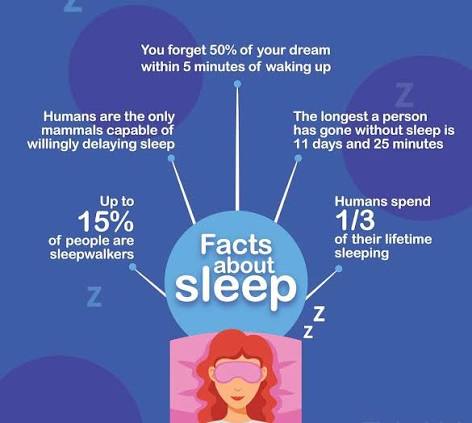
1. Humans are the only mammals that can voluntarily delay sleep.
2. Humans spend about one-third of their life sleeping, although this varies with age, it’s approximately one-third on average, which is quite significant.
3. Cats spend two-thirds of their life sleeping.
4. Giraffes need only 1.9 hours of sleep per day.
5. A brown bat needs about 19.9 hours of sleep daily.
6. Snails can sleep continuously for 3 years.
7. Marine otters sleep holding hands so they don’t drift apart.
8. Rabbits can sleep with both eyes open.
9. Horses can sleep standing up.
10. Dolphins sleep with one eye open, remaining alert even while sleeping, which helps them stay safe from predators like sharks.
11. When dolphins sleep, half of their brain is asleep while the other half remains alert to breathe, so they cannot sleep completely.
12. Lack of sleep kills humans more quickly than lack of food or water; humans can survive 2 months without food, 30 days without water, but only 11 days without sleep.
13. The record for the longest wakefulness is 11 days, set by Randy Gardner, a student from California in 1964.
14. Generally, most healthy adults need 7 to 9 hours of sleep per night, although some can perform well after only 6 hours without drowsiness, while others perform better after sleeping up to 10 hours.
15. People who sleep less than 7 hours a night have a 12% higher risk of early death.
16. Adults who sleep less than 7 hours at night are more likely to suffer from asthma, cancer, and diabetes.
17. Sleeping less than 7 hours per night can make you angry, depressed, and stressed.
18. Women tend to sleep longer than men.
19. Newborns sleep 14 to 17 hours a day; their brains utilize 50% of the glucose supply, hence they need more sleep.
20. Parents of newborns lose about 6 months of sleep during the first two years of their baby’s life.
21. You cannot sneeze while sleeping; if you’ve seen someone sneezing while asleep, their sleep was interrupted to complete the sneeze.
22. Humans cannot smell while sleeping; if there is a gas leak or smoke in the house during sleep, it often goes unnoticed.
23. The higher the altitude, the more sleep disruptions occur; generally, at heights above 13,200 feet, sleep irregularities increase.
24. The main reason for sleep disturbances at high altitudes is reduced oxygen levels, which affect respiration; most people need two to three weeks to adjust.
25. We cannot sneeze while sleeping.
26. When stressed, people dream three to four times more than usual.
27. Lack of sleep can shrink the brain.
28. You can survive without eating for several weeks, but only about 11 days without sleep.
29. The average person takes about 7 minutes to fall asleep.
30. Watching television while sleeping burns more calories.
31. Newborns sleep a total of 14 to 17 hours per day.
32. Those who sleep less than 6 hours may experience anger, sadness, and stress.
33. Regular exercise generally makes falling asleep easier.
34. On average, humans spend about one-third of their life (around 25 years) sleeping.
35. Cats are very lazy; they spend about 70% of their lives sleeping.
36. Sleep deprivation can lead to early forgetfulness or dementia.
37. Dolphins sleep with only half of their brain at a time, keeping the other half alert.
38. Giraffes need only about 30 minutes of sleep in 24 hours.
39. ‘Dysania’ is a condition where waking up in the morning feels extremely difficult.
40. Sometimes, when we try to sleep, even the ticking of a clock can irritate us a lot.
41. When sea otters sleep, they hold each other’s hands so they don’t drift apart.
42. The period between 3:00 AM and 4:00 AM is when our body is at its weakest. That is why most people’s deaths occur during this time.
43. By the time a human child is two years old, the parents sleep about 1,055 hours less because of the child.
44. Insomnia complaints are most common among divorced, widowed, and separated people.
45. Gibbons can sleep continuously for three years.
46. When your sleep opens just a little before your alarm goes off, this state is called the circadian rhythm.
47. Insomnia is the most common sleep disorder.
48. In 1849, David Atison served as the President of the United States for only one day and spent most of that time sleeping in bed.
49. A rabbit can sleep while keeping its eyes open.
50. All people are in a dream world while sleeping, and those who cannot dream are called in scientific terms (Personality Disorders).
51. People who regularly fly for work may face a risk of sleep deprivation. Flying at high altitudes causes sleep disturbances due to a lack of oxygen.
52. Our body feels most tired at 2:00 PM and 2:00 AM.
53. A week of sleep deprivation can cause your body weight to increase by up to 1 kilogram.
54. Scientists have not yet discovered why humans dream.
55. About 15% of people worldwide have sleepwalking, and 5% have sleep talking.
56. Using your mobile or laptop before going to bed can affect your sleep.
57. Those suffering from back pain have the worst sleep.
58. The fear associated with sleep is called (Somniphobia).
59. People who wake up early in the morning are more likely to be successful.
60. People with a sluggish or cold temperament tend to have more difficulty falling asleep.
Sleeping Facts in English
61. Most people forget about 90% of their dreams.
62. Research shows that having a newborn affects men’s sleep more than women’s.
63. In Japan, there is a technique called inemuri, where anyone can sleep for a while during work. Unlike in other countries, sleeping at work in Japan does not lead to anger or dismissal; it is considered a sign of work fatigue.
64. The brain does not create new faces while dreaming; we only see faces of people we have seen before.
65. According to a study, before color TV was common, 80% of people saw black and white dreams.
66. A study indicates that sleeping less than 7 hours at night increases the risk of premature death by 12%.
67. In 1964, 17-year-old Randy Gardner set a world record by staying awake for 264 hours and 12 minutes (11 days).
68. Due to lack of sleep, your brain forgets to distinguish between important and unimportant things.
69. Many Tibetan Buddhist monks sleep standing or sitting.
70. According to a study, people who sleep less or wake up late have their hormone levels decrease rapidly.
71. Research shows that 70% of college students suffer from sleep problems.
72. Women tend to have more nightmares than men, and their dreams are often more emotional.
73. Humans are the only mammals who sleep voluntarily; they can fall asleep early or late as they wish.
74. Horses can sleep while standing.
75. Normally, regular exercise makes falling asleep easier; however, exercising right before bed can make it difficult to fall asleep.
76. Divorced, widowed, and separated people are more prone to insomnia.
77. Caffeine is considered the most popular drug for sleep. People worldwide consume caffeine daily through coffee, tea, cacao, chocolate, some soft drinks, and medications.
78. We naturally feel most tired at two different times of the day: 2:00 AM and 2:00 PM.
79. Between 3 and 4 in the morning, the human body is at its weakest, which is why most deaths occur during sleep at this time.
80. About 90 million American adults experience sleep disturbances, primarily caused by snoring. Regularly, around 37 million people have sleep issues due to snoring.
81. People who do not get enough sleep experience a drop in the levels of the appetite-regulating hormone leptin, which makes them more likely to feel hungry and increases their appetite.
82. Using sign language during sleep is not unusual for deaf people; there are many instances where people have reported their deaf partners or children using sign language in their sleep.
83. ‘Dysania’ is a condition in which waking up in the morning feels very difficult.
84. Parasomnia is a state in which people perform various activities during sleep, such as walking in their sleep, driving while asleep, and sometimes even committing crimes like murder while in a parasomnia state.
85. The grinding of teeth during sleep is called ‘Bruxism.’
86. In a condition called ‘Sleep Apnea,’ breathing stops during sleep, causing the person to wake up suddenly and sit up with a jerk.
87. The problem of stopping breathing during sleep can last from a few seconds to several minutes. Just as a person who snores might not realize they are snoring, in sleep apnea, the person may not notice that their breath has stopped.
88. According to estimates from the ‘National Sleep Foundation,’ about 15% of the world’s population sleepwalk. There is a common misconception that one should not wake a sleepwalker, but in reality, this is a myth.
89. About 5% of people worldwide suffer from the sleep disorder known as somniloquy (sleep talking).
90. Ideally, it should take you 10 to 15 minutes to fall asleep after going to bed at night; if it takes less than 5 minutes, there is a possibility that you are suffering from sleep deprivation.
91. Sleeping on the stomach helps with digestion. Sleeping on the left side reduces heartburn.
92. The best sleeping position for health is lying on your back because in this position, the back, neck, and spine remain in a neutral position, providing complete rest to the body.
93. Drinking coffee just before sleeping causes the internal body clock to shift backward by 40 minutes.
94. Those suffering from back pain tend to have the worst sleep.
95. Exercising for 30 minutes every day can increase sleep duration by 14 minutes per night.
96. According to a study, the best sleep occurs on the night of the new moon, and the worst on the full moon.
97. Insomnia generally increases with age, but sometimes sleep disturbances can be caused by medical conditions.
98. The reason why sleep deprivation reduces the ability to tolerate pain is not yet known.
99. Lack of sleep can affect a person’s memory.
100. Using your phone or tablet before bed can affect your sleep. Any kind of light before sleeping is not good; the secretion of the sleep hormone ‘melatonin’ is affected by light, especially blue light, which makes blue light twice as harmful for sleep.
Read Also:
- Effects Of Mobile: Children Have Mobile In Their Hands Alarm Bells, Know 4 Bad Effects
- 8 Harmful Effects Of Mobile Phones On Children
- If You Watch More Porn, These 5 Big Losses Will Happen To Sex Life
- Serious Disadvantages Of Watching Porn
- Understanding The Impact Of Porn And Masturbation: Sticking To Your Goals
- Does Excessive Use Of Airpods Cause Brain Tumors? What Does Research Say, How Much Sound Is Limited, Know Everything
- The Truth About Airpods And EMF Radiation: What You Need To Know
- Important Information About Mobile Phone
- The Effects Of Micro Waves (Mobile And Oven)
- Understanding The Dangers Of Porn Addiction: An Appeal To Awareness And Action
- The Hidden Health Effects Of Pornography: Understanding Addiction And Recovery
- Understanding The Real Dangers Of Pornography Addiction
- Mobile Phone Addiction: A Hidden Threat To Your Brain And Health
- Hidden Dangers: Side Effects Of Mobile Phone Addiction
- Advantages And Disadvantages Of Mobile Phones
- How Porn Affects Your Mind And Relationships
- The Truth About Airpods And EMF Radiation: What You Need To Know
- Harmful Effects Of Mobile Phones On Human Health
- Advantages And Disadvantages Of Mobile Phones
- If You Use Your Phone Too Much Then You Can Get These 5 Diseases, Protect Yourself In This Way
- Understanding Radiation: Separating Fear From The Truth In An Unseen World
- What Effect Does Using Too Much Mobile Have On The Brain
- 10 Losses From Mobile
- Bad Effects Of Mobile Phone On Eyes
- Ignored Exposure: Mobile Phone Radiation, Increasing Health Risks, And The Need For Caution