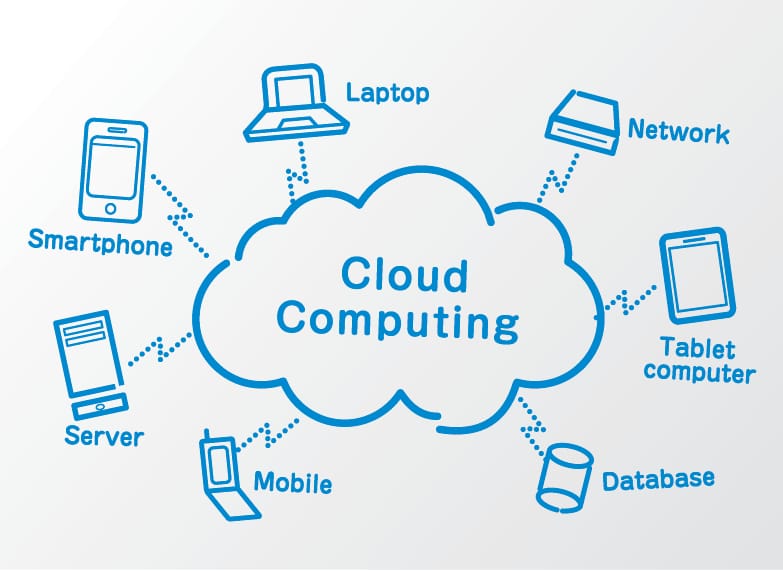



Cloud computing is a type of computing that relies on sharing computing resources rather than local servers or personal devices to handle applications. In cloud computing, the term cloud (also called cloud) is used metaphorically for the Internet, so the term cloud computing means a type of Internet-based computing, where various services – such as servers, storage, and applications – are delivered to an organization’s computers and devices via the Internet. Cloud computing can be compared to grid computing, which is a type of computing where unused processing cycles of all computers in a network are used to solve problems that are too complex for any stand-alone machine. As previous events show, computing in its purest form has changed hands many times. From the very beginning, when mainframes were considered the future of computing. In fact, mainframes and large-scale machines were manufactured and used, and in some circumstances are still used as such today. However, the trend has turned from larger and more expensive to smaller and more affordable commodity PCs and servers.
Most of our data is stored on local networks, with servers that can be clustered and share storage. This approach has found time to evolve into stable architectures and provide decent redundancy when implemented correctly. A new emerging technology, cloud computing, has come up for attention and is rapidly changing the direction of the technology landscape. Whether it’s Google’s unique and scalable Google filesystem, or Amazon’s robust Amazon S3 cloud storage model, it’s clear that cloud computing has come with a lot to learn from. In dealing with the abstract term, “cloud”, it is easy to misunderstand what structure and functions are. The original work comes from “Cloud”. Input is what turns the cloud on. Don’t confuse cloud computing with the term data center, as it is usually on top of the latter
As new technologies emerge, they are often based on the success of previous technologies. Cloud computing and storage leverage years of massive infrastructure development and testing. Most importantly, cloud storage is for everyone and every organization. From large to small, from group to individual, grid infrastructure can be used for maximum benefits and efficiency. ‘Cloud’ itself is a metaphor for the Internet. Whenever a person uses the Internet to search for a word on Google or uses their web-based email services to send or receive emails, they are using a cloud application. A person who uses Facebook or other social networking sites is using a cloud application. In fact, file sharing, hosting services, and email were the first cloud applications when the Internet began to evolve. So, every person who has ever surfed the internet or used Hotmail or Google Mail has already used the cloud. Yet, despite the concept of cloud being nothing new, ‘cloud computing’ is revolutionizing the way data computing is done in the world.
Cloud computing means maintaining data and applications using the Internet and central remote servers, rather than placing data and applications on separate mainframe computers or PCs. This means that a person can access all his files anywhere by clicking on the Start menu of any computer in the same way as he is using his desktop or laptop computer. As a result, a person can work on anyone’s computer as easily as if they were working on their computer in their office. The files appear to be loaded on that computer’s hard drive, when in reality they are not located on that computer and are downloaded to that computer from the cloud/internet.
Cloud computers are enabled by a highly available, reliable group of computing resources, which can be paid for as a service and which eliminates the need for mainframes, hardware, software, and other IT infrastructure. In simple terms, cloud computing has transformed IT infrastructure into a service. As commentators have accurately described, cloud computing has turned software and computing into a utility in the same way that electricity or water supply is a utility. Cloud computing has changed the use of computing resources from a mainframe system or an individual user-operated PC to a metered service, in which users pay for their use, much like electricity or water is a metered service. Thus, cloud computing has replaced large, upfront capital investments in IT infrastructure with data computing and storage from very low, pay per use (PE) to cloud service providers.
The financial and availability benefits of cloud computing are immediately apparent. By using cloud computing services, companies no longer need to make large, upfront capital investments in hardware, software, and other IT infrastructure. As a result, businesses avoid the huge costs of maintaining their hardware infrastructure and servers and purchasing software licenses. Companies can also gain access to their data more cheaply as the cloud centralizes storage, memory, processing, and bandwidth, reducing costs and giving users the benefit of economies of scale.
Benefits Of Cloud Computing
Since cloud computing is a scalable, metered service, the user can quickly scale up computing resources when there is high demand for them and reduce it when demand is low, thus reducing costs. In contrast, a company that has invested capital in IT infrastructure has to incur initial costs, it has to pay recurring maintenance costs and if its own computing requirements are reduced, it cannot reduce it. Companies can increase their profit margins as the cloud reduces operating costs, providing easier mobility and better storage systems of data. In short, running applications purchased from ‘Cloud’ is much more efficient and cheaper than running your own computer systems and applications.
Cloud computing allows consumers and businesses to use applications without installation and access their personal files stored online. Previously, different software applications had to be installed on the same system. With the advent of cloud computing, a single application provides the user with access to a web-based cloud that hosts all programs needed to meet word-processing as well as all other computing needs of an individual. The cloud user will never suffer a loss of data because his PC’s hard drive has crashed or the software has been corrupted. If the cloud subscriber’s PC fails or is stolen, the subscriber only needs to download his data from the cloud and he also does not need to restore files from back-up or try to restore data from his PC. Will not happen. Cloud computing in short refers to technologies that provide software, data access, storage devices that do not require the physical location of the system. The main advantage over traditional forms of applications is that cloud computing does not have to rely on physical structure for its operations. A very interesting feature of cloud computing is that, as mentioned above, the interoperability of different interfaces is imperative. Accordingly, the development of cloud computing will inevitably lead to the development and use of open source software.
Types Of Cloud Computing
There are three main models of cloud computing: public cloud, private cloud, and hybrid cloud.
1. Public Cloud Computing: A public cloud is one in which the infrastructure and other computational resources involved are made available to the general public via the Internet. Public Cloud is owned by a provider selling cloud services and is external to the user’s organization. As discussed below, the public cloud poses the greatest risk in terms of data security because anyone subscribing to the cloud can access it. Public cloud is of ‘multi-tenant’ nature because data from one company is essentially stored on the public cloud along with data from another company, so data separation is a very important issue.
2. Private Cloud Computing: A private cloud (also called an internal cloud) is one in which the computing environment operates exclusively for a particular company or organization. Private Cloud provides services to a limited number of users behind the firewall. Private cloud can be managed by the organization/company itself or by a third party and can be hosted within or outside the organization’s data center. A private cloud is like an intranet, with access limited to employees of a particular company or organization. Community cloud is very similar to private cloud, except that it is used by two or more organizations. Private cloud is commonly used by a large company and provides various applications to upgrade or downgrade resources as needed. Private cloud, of course does not offer the basic advantage of cloud computing as the user still has to bear the initial capital costs in creating their own private cloud, however, these costs should be lower than those incurred in creating their traditional IT infrastructure in the long term Furthermore, the use of private clouds means that the user is making more efficient use of assets rather than setting up traditional IT infrastructures.
In addition, operating expenses will be reduced due to lack of hardware and other IT infrastructure when installing private clouds. The cloud’s metering capabilities are also expected to increase transparency in the business process. Additionally, the private cloud offers the advantage of greater flexibility, allowing the user to enhance and order services when needed.
Public, Private, Hybrid And Community Clouds
Public Clouds: Public clouds are the most common and can be used by both organizations and individuals. There are about 100 million users on the public cloud. Anyone can access well-known public cloud services through the Internet. Well-known examples of this are Google applications or Amazon Web Services.
Private Cloud: Private cloud is mostly used by organizations. This provides greater control and security over the data as it is hosted on the site rather than on external servers. A private cloud can be accessed on the web, but the data is secure and controlled behind the organization’s firewall. Others, including SUNGUARD, trackspace and terremark, offer these types of private clouds.
Hybrid Cloud: Hybrid cloud is a rapidly growing cloud type. These combine private cloud and public cloud. The advantage is that access to public cloud services can be achieved while ensuring the security and control of the private environment. Sensitive data can be hosted on the private side while access to features is possible on the public cloud. Thus, hybrid cloud is a way for IT to take control of sensitive data, as well as meet users’ demand for public cloud services. A hybrid cloud is a combination of two or more clouds (private or public) that remain separate cloud units, but share some technologies that allow inter-operability. A type of hybrid cloud is called ‘cloud bursting’, where a service provided by a private cloud, when it needs to meet maximum demand, automatically accesses and uses resources from the public cloud. Can do. The hybrid model means that companies can extend their private cloud networks to public cloud service providers.
Community Clouds: Community clouds are a private form of cloud, yet they are shared by many organizations in an industry. These are limited to specific users who share common resources. For example, Clinovo offers community cloud-based hosting clinical application services for its customers.
Service Model
There are three main types of services provided by cloud computing providers: Infrastructure-as-a-Service, Software-as-a-Service and Platform-as-a-Service, these are frequently used cloud service models.
1. Infrastructure-as-a-Service (IaaS): ‘Infrastructure-as-a-Service’ (IaaS) is the process of selling hardware, storage, and networks as a service. Infrastructure-as-a-Service (IaaS) is the most basic model, which involves providing only basic storage and data hosting. IaaS provides the basic computing infrastructure of servers, software and network devices as an on-demand service on which a platform can be set up to develop and execute applications. The advantage of IaaS is that the customer/user does not need to purchase, own and manage basic hardware and software infrastructure components and can obtain these resources from the service provider. The customer can choose the operating system and development environment. IaaS is becoming increasingly attractive as the requirements for data collection are increasing rapidly as a result of the increased connectivity of industrial and other infrastructures to the Internet.
2. Software-as-a-service (SaaS): The second model is SaaS. In this model, the cloud provider provides software to access, manage, and use the data. An example of SaaS are email service providers such as Gmail, Yahoo Mail, Hotmail, and social media sites such as Facebook, LinkedIn, and Twitter. SaaS means that one or more applications, and the computational resources to run them, are made available for use on demand as a turn-key service. SaaS has the advantage of reducing the cost of hardware, software development and maintenance for the user/customer. The customer does not manage cloud infrastructure or individual applications and can only do some limited administrative application settings. Before the advent of cloud computing, users had to purchase licenses to use software applications. Cloud computing has now turned software into a service. Instead of purchasing software, the user pays for the use of the cloud feature that the software application provides.
3. Platform-as-a-service (PaaS): The third model is ‘Platform-as-a-service’ (PaaS). PaaS, is the selling of an application development platform as a service. An example of PaaS is Facebook allowing third parties to create and distribute applications within its service. PaaS, is to provide a computing platform as an on-demand service on which applications can be developed and deployed. PaaS, provides tools for developing applications in a standard environment allowing new businesses and applications to be developed quickly with less risk. The PaaS model aims to reduce the cost of purchasing, housing and managing the hardware and software required for the platform. However, the subscriber has control over the application and the application environment settings of the platform.
Cloud Computing And India
According to reports, there are 8 million small-to-medium-sized businesses in India that are potential users of cloud computing services. The estimated size of the Indian cloud computing market in 2009 was $66.7 million (approximately Rs 300 crore) and is expected to grow at a compound annual growth rate (CAGR) of 40% over the next five years. According to IDC’s India Cloud Computing Market – Current Status and Future Roadmap Study, 2010, the share of cloud computing in large and medium-sized enterprises is expected to increase to 6.8% by 2012. The Indian cloud market is expected to be worth $3 billion by 2015. According to a survey by Gartner, two-thirds of Indian CIOs expect most ITs to work on the cloud within the next four years. The advent of cloud computing in India is expected to attract additional foreign investment. Foreign companies are expected to establish their base in India due to good operating systems, data storage facilities and low cost availability. Many Indian companies, especially in the telecom and healthcare sectors, have adopted the hybrid cloud model. However, some challenges are hindering the development of computing in India, such as lack of reliable supply of electricity and internet.
Legal Issues
Cloud computing raises many legal issues. Because cloud computing involves huge amounts of information being stored and processed in the cloud, it leads to complex issues of data security and privacy, especially in public clouds, where data from different companies is stored together in the same cloud. It is important for service providers to provide encryption codes to customers to protect the information contained on the cloud. Data portability is another major issue among service providers. Second, cloud computing raises serious issues related to cybercrime and hacking because a cloud environment is not a traditional secure network. Rather, it is an environment in which any user/customer can access and use it. This means that a hacker can come out as a user to insert bots or other malware into the cloud. Thirdly, cloud computing raises issues related to the protection of intellectual property rights. The first question is who owns the data stored in the cloud? The immediate answer is that the intellectual property rights (IPR) in the work stored on the cloud will be held by the customer. However, in the cloud, information is constantly added, deleted or modified and new information is created. Therefore, it is important to clarify that all intellectual property rights in the compilation of information produced in the cloud are owned by the customer.
Cloud computing also raises complex issues related to jurisdiction. In e-commerce, a key element determining jurisdiction is physical location. Common criteria include a house computing center that allows the enterprise to know where data is located and ways to keep data secure on the cloud. However, sometimes service providers do not disclose the location of the data. Problems arise when data flows to another jurisdiction. Often, even cloud computing service providers do not know exactly where the data is located. Data can be located in multiple countries, raising complex questions related to jurisdiction. This chapter examines issues related to data security and privacy as well as cybercrime in the context of cloud computing.
Cloud Computing And Cyber Crime
Cloud computing is not a traditional secure network on the Internet where access from outside the network is completely restricted. Instead, in the case of cloud computing, any customer with access from outside the network can, when having Internet access, log into the public cloud. Security is a major concern because data is not locked in a secure place. Instead, data computing in the cloud shares resources with the data of others and can be accessed by cybercriminals if it is not properly secured. According to reports, the increasing use of cloud computing technology by companies has led to a significant increase in attacks on companies using virtualized and cloud-based environments. Hackers are reportedly targeting companies using web-based applications used to store sensitive financial, employee, corporate and medical information through web-based intrusion attacks.
According to the Trend Micro 2010 Future Threat report, ‘Cloud computing and virtualization move servers out of the traditional security perimeter and increase the playing field for cybercriminals’ The failure of Danger/Sidekick’s cloud-based servers led to massive data outages in November 2009, evidencing the risks that cybercriminals take. Cloud risks increase as information moves through public cloud systems and once you release the data, it becomes almost impossible to control where it will go later. Furthermore, large companies are less likely to report attacks on the cloud. Encryption is also not a sure way to avoid problems. Problems will arise with who holds the key to encryption. Additionally, if the data is processed in the cloud, decryption may be required. Some progress has been made with the advent of technological improvements. The hardware and virtualization layers were previously an esoteric ‘black box’. Now, these layers can be inspected, analyzed, and reported for compliance in the same way as the cloud’s topmost application service layer. New data privacy technologies also exist, such as encrypted volumes, point-to-point secure communications, and secure database transactions, which are new security mechanisms that will secure cloud data platforms.
Conclusion
Cloud computing is a revolutionary change in the Internet age and technology is revolutionizing the way delivery is done. However, the benefits of cost, flexibility, and availability that users of cloud services enjoy also bring new challenges against cybercrime, data security, protection of intellectual property rights, and jurisdictional issues. Indian legislators and courts have not yet responded to the new cloud computing phenomenon, so it is important to keep an eye on it in the near future.
Read Also:
- Security Issues Of E-Commerce
- Cyberterrorism And Cyberattack
- Protection Of Your Personal Data From Fraud And Scams
- Detecting Fraud And Scams From Communications
- Artificial Intelligence (AI) Fraud Scams
- Never Pay For A Job: Understanding The Trap
- Always Use Trusted Platforms To Avoid Fraud And Scams
- The Hidden World Of Task Scams: A Modern Epidemic
- Fake Offer Letter Scams: The Misleading Trap Of Employment Fraud
- Important Tips And Methods To Protect Your Personal Data From Fraud And Scams
- Big Scams And Controversies Related To Mamata Banerjee And Trinamool Congress (TMC)
- Reshipping Scams: Modern Global Fraud That Exploits Trust And Opportunity
- Working From Home Scams: The Hidden Epidemic Of Modern Labour Fraud
- Phishing And Email Scams
- The World Of Advance Fee Fraud
- The Dark Truth About Fake Job Listings And Fraudulent Websites
- Rise Of Fraudsters And Scammers In Contemporary India
- Image Of Mamata Banerjee As The Main Fraudster In India
- Understanding Skype Accounts
- Auditor Should Develop New Ways Of Preventing Fraud In Government Departments, Improving Capacity: Modi
- Digital Fraud Doubled Home Ministry Told Parliament-UPI Also Included
- Attention Cyber Attackers Are Hidden In Your Phone, Government Warns, Told The Way To Rescue
- New Law To Surf Torrent Site In India
- What You Should Do If You Are Getting Cyber-Bullies
- What To Do When Online Shopping Fraud? Cyber Fraud Complaint, Return Money And Rescue
- Damage On Social Media Defamation Streams, Punishment And Complaint Process
- What Is Cyberstalking Punishment, Act And Complaint Process