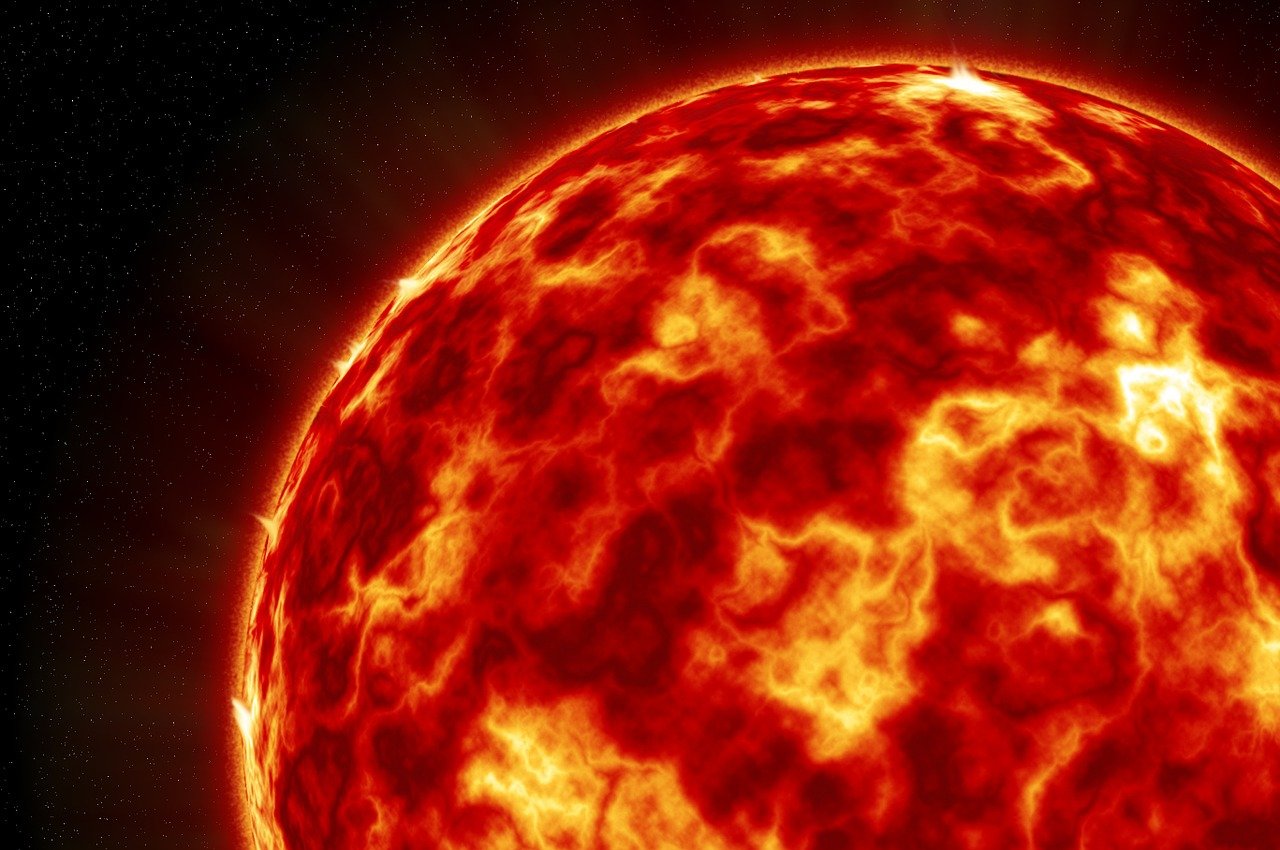



The Sun is a star located at the center of the solar system around which the Earth and other components of the solar system rotate. The Sun is the largest body in our solar system, and its diameter is about 13 lakh 90 thousand kilometers, which is 113 times more than the Earth. This powerful storehouse of energy is mainly a huge ball of hydrogen and helium gases. The Sun produces energy at its center through the process of nuclear fusion. Only a small part of the energy emitted from the Sun reaches the Earth, out of which 15 percent is reflected into space, 30 percent is used to make water vapour, and much of the energy is absorbed by trees and plants in the ocean. Its strong gravitational force keeps the Earth and other planets moving towards it while rotating in different orbits.
The average distance of the Earth from the Sun is approximately 149,600,000 kilometers or 92,960,000 miles, and it takes 8.3 minutes for light to reach the Earth from the Sun. With this light energy, an important biochemical reaction called photosynthesis takes place, which is the basis of life on Earth. It affects the Earth’s climate and weather. The surface of the Sun is made up of the elements hydrogen, helium, iron, nickel, oxygen, silicon, sulphur, magnesium, carbon, neon, calcium, and chromium. Of these, hydrogen is 74% of the surface of the Sun, and helium is 24%.
When this burning gaseous body is viewed through a telescope, small and big spots are visible on its surface. These are called sunspots. These spots appear to be moving from their place. From this, scientists have concluded that the Sun makes one revolution on its axis from east to west in 27 days. Just as the Earth and other planets revolve around the Sun, the Sun also revolves around the center of the Milky Way. It takes 22 to 25 million years to revolve; this is also called a nebular year.
Features
The Sun is a G-type main sequence star that comprises about 99.86% of the total mass of the Solar System. It is nearly spherical, with an estimated oblateness of about nine millionths, meaning that its polar diameter differs from its equatorial diameter by only 10 km. As the Sun is composed of plasma and not a solid, it rotates more rapidly at its equator than at its poles. This behavior is known as differential rotation and is caused by the movement of matter due to the Sun’s convection and extreme temperature gradient outward from the core. It carries a large portion of the Sun’s counterclockwise angular momentum, as seen from the north pole of the ecliptic, and thus redistributes the angular momentum. This actual rotation period is approximately 25.6 days at the equator and 33.5 days at the poles. However, due to our constantly changing position relative to Earth as we revolve around the Sun, the apparent rotation of this star at its equator is approximately 28 days. The centrifugal effect of this slow rotation is 18 million times weaker than the surface gravity at the Sun’s equator. The tidal effects of the planets are also weak and do not significantly affect the shape of the Sun.
The Sun is a Population I, or heavy element-rich, star. The formation of the Sun may have been initiated by bow waves emanating from one or more nearby supernovae. This is suggested by the high abundance of heavy elements in the Solar System, such as gold and uranium, rather than the abundance of these elements in so-called Population II (heavy element-deficient) stars. These elements are most likely produced by exothermic nuclear reactions during a supernova or by transformation via neutron absorption within a second-generation giant star.
The Sun has no definite boundaries like the rocky planets. The density of gases in the Sun’s outer regions falls rapidly with increasing distance from its center. However, it has a well-defined internal structure, described below. The Sun’s radius is measured from its center to the edge of the halo. The Sun’s outer corona is the last visible layer. The layers above are too cool or too thin to emit enough light to be visible to the naked eye. During a total solar eclipse, however, when the corona is obscured by the Moon, the Sun’s corona can be easily seen around it.
The interior of the Sun is not directly observable. The Sun itself is opaque to electromagnetic radiation. However, just as seismology uses the waves generated by earthquakes to reveal the internal structure of the Earth, solar seismology uses pressure waves (ultrasound) to measure and visualize the internal structure of the star. Computer modelling has also been used as a theoretical tool to investigate its deeper layers.
Core
The Sun’s core is thought to extend from its center to about 20–25% of the solar radius. It has a density of up to 150 g/cm³. (about 150 times the density of water) and a temperature of about 157 million Kelvin. In contrast, the Sun’s surface temperature is about 5,800 Kelvin. Recent analysis of SOHO mission data favors a faster rotation rate of the core than the rest of the radiation field. For most of the Sun’s life, energy has been produced by nuclear fusion through a stepwise series called the p–p (proton–proton) chain; this process converts hydrogen into helium. Only 0.8% of the Sun’s energy produced comes from the CNO cycle.
The core is the only region in the Sun that produces a large amount of thermal energy through fusion; 99% of the power is generated within 24% of the Sun’s radius, and by 30% of the radius fusion has almost completely stopped. The remainder of the star is heated by energy that has been transferred outward by radiation from the core to just outside the convective layers. The energy produced by fusion in the core then must travel through successive layers into the solar corona before it escapes into space as sunlight or the kinetic energy of particles.
The proton-proton chain in the core is found 9.2×1037 times every second. This reaction uses four free protons (hydrogen nuclei), converting about 3.7×1038 protons into alpha particles (helium nuclei) every second (out of the Sun’s total ~8.9×1056 free protons), or about 6.2×10¹¹ kg per second. Helium is released as energy after hydrogen to helium fusion. The fusion releases about 0.7% of the mass; the Sun releases energy at a mass-energy conversion rate of 426 million metric tons per second, 384.6 yotta watts (3.846×1026 watts), or 9.192×10¹⁰ TNT megatons per second. The mass is not destroyed in producing energy; rather, this mass is transformed into an equivalent amount of energy and carried away to be emitted, as described by the concept of mass-energy equivalence.
The power output from fusion in the core varies with distance from the solar center. At the center of the Sun, theoretical models estimate this to be approximately 276.5 W/m³.
Life Cycle
The Sun is at its most stable today, about halfway through its life. It has not changed dramatically for several billion years and will likely remain unchanged for many years to come. However, a star before and after a stable hydrogen-burning period is quite different.
1. Construction
The Sun formed about 4.57 billion years ago from the collapse of part of a giant molecular cloud composed mostly of hydrogen and helium that may have given rise to many other stars. This age has been estimated through the use of computer models of stellar evolution and nucleocosmochronology. The result is consistent with the radiometric date of the oldest solar system material, 4.567 billion years. Studies of ancient meteorites show traces of stable nuclei of short-lived isotopes, such as iron-60, which are formed only in exploded, short-lived stars. This indicates that one or more supernovae must have been found near the location where the Sun formed. A shock wave from a nearby supernova may have triggered the formation of the Sun by compressing the gases within the molecular cloud, and some regions may have formed by collapsing under their own gravity. As a piece of the cloud collapsed, due to conservation of angular momentum, it also began to rotate and heat up with increasing pressure. A large amount of matter concentrated in the center, while the rest flattened out into a disk that formed the planets and other solar system bodies. Gravity and pressure within the cloud’s core generated immense heat as more gas was added from around the disk, eventually activating nuclear fusion. Thus, Surya was born.
2. Main Sequence
The Sun is about halfway through its main sequence phase, during which nuclear fusion reactions convert hydrogen into helium. Every second, more than four million tons of matter within the Sun’s core are converted into energy and create neutrinos and solar radiation. At this rate, the Sun has already converted about 100 Earth masses’ worth of matter into energy. The Sun will spend as much as 10 billion years as a main sequence star.
3. After Core Hydrogen Closure
The Sun does not have enough mass to explode as a supernova. Regardless, it will enter a red giant phase. The Sun is predicted to become a red giant in approximately 5.4 billion years. It has been estimated that the Sun will probably become large enough to swallow the current orbits of the inner planets of the Solar System, including Earth.
Before it becomes a red giant, the Sun’s luminosity will nearly double, and Earth will be even hotter than Venus is today. Once the core hydrogen is exhausted, the Sun will expand into the subgiant phase and slowly double in size over about half a billion years. It will then expand even more rapidly over the next half billion years, until it becomes two hundred times larger and tens of thousands of times more luminous than today. This is the stage of the red giant branch where the Sun will have spent about a billion years and lost about a third of its mass.
The Sun only has a few million years left, but it is extremely short. First, the core burns violently in a helium flare and shrinks back to about 10 times its recent size, with 50 times the Sun’s luminosity and slightly cooler temperatures than today.
4. Solar Space Mission
The first satellites designed to observe the Sun were NASA’s Pioneer 5, 6, 7, 8, and 9. These were launched between 1959 and 1968. These spacecraft made the first detailed measurements of the solar wind and solar magnetic field while orbiting the Sun in an orbit equidistant from the Earth and the Sun. Pioneer 9 operated for a particularly long period of time, transmitting data until May 1983.
In the 1970s, the two spacecraft Helios and the Skylab Apollo telescope on Mount En provided scientists with important new data on the solar wind and solar corona. The Helios 1 and 2 spacecraft were a US-German collaboration. It studied the solar wind from an orbit leading the spacecraft to the perihelion within the orbit of Mercury. In 1973, the Skylab space station was launched by NASA. It included a solar observatory module called the Apollo Telescope Mount that was operated by astronauts living on the station. For the first time, Skylab made close observations of the solar transition region and ultraviolet emissions from the solar corona. Discoveries included the first observations of coronal mass ejections, then called “coronal transients,” and then coronal holes, now known to be closely associated with the solar wind.
The Solar Maximum Mission of 1980 was launched by NASA. The spacecraft was designed to observe gamma rays, X-rays, and ultraviolet radiation from solar flares during periods of high solar activity and solar flares. Just a few months after launch, however, an electronics failure left the spacecraft stranded, and it spent the next three years in an inactive state. In 1984, the Space Shuttle Challenger mission STS-41C recovered the satellite and repaired its electronics before re-releasing it into orbit. The Solar Maximum mission acquired thousands of images of the repaired solar corona before re-entry into Earth’s atmosphere in June 1989.
Launched in 1991, Japan’s Yonkoh (solar beam) satellite observed solar flares at X-ray wavelengths. Mission data allowed scientists to identify many different types of flares and also showed that the corona, located away from areas of peak activity, was more dynamic and active than previously thought. Yonkoh observed an entire solar cycle but went into emergency mode when an annular solar eclipse occurred in 2001, causing it to lose its connection with the Sun. It was destroyed during atmospheric reentry in 2005.
The most important solar mission to date has been the Solar and Heliospheric Observatory. Launched on December 2, 1995, the mission was jointly created by the European Space Agency and NASA. It was originally scheduled for a two-year mission. The mission was approved for extension until 2012 in October 2009. It proved so useful that its follow-up mission, the Solar Dynamics Observatory (SDO), was launched in February 2010. It was placed at the Lagrangian point between the Earth and the Sun (at which the gravitational pull on both sides is equal). SOHO has provided continuous images of the Sun at multiple wavelengths since its launch. In addition to direct solar observations, SOHO has been enabled to discover a large number of comets, the majority of which are small sungrazers that burn up as they pass the Sun.
All these satellites have observed the Sun from the plane of the ecliptic; hence, observations have been made only in its equatorial regions. The Ulysses spacecraft was launched in 1990 to study the Sun’s polar regions. It first travelled to Jupiter before being driven into a distant orbit above the plane of the ecliptic by Jupiter’s gravitational force. Coincidentally, it was well placed to observe the 1994 collision of comet Shoemaker–Levy 9 with Jupiter. Once Ulysses was established in its intended orbit, it began observing the solar wind and magnetic field strength at high solar latitudes and found that the solar wind, moving at about 750 km/s at high latitudes, was slower than expected, and that there were large magnetic waves coming from the high latitudes that were scattered galactic cosmic rays.
The elemental abundance of the chromosphere is well known from spectroscopic studies, but the Sun’s interior structure is equally poorly understood. The solar wind sample return mission, Genesis, was designed by astronomers to directly measure the composition of solar material. Genesis returned to Earth in 2004 but was damaged by an accidental landing when its parachute failed to deploy upon reentry into the Earth’s atmosphere. Despite severe damage, some useful samples have been recovered from the spacecraft’s Sample Return Module and are undergoing analysis.
The Solar Terrestrial Relations Observatory (STEREO) mission launched in October 2006. Two identical spacecraft were launched into orbits in a way that would (alternately) pull them far ahead and slowly fall behind the Earth. It is capable of performing three-dimensional mapping of the Sun and solar phenomena, such as coronal mass ejections.
The Indian Space Research Organization has scheduled the launch of a 100 kg satellite named Aditya for 2015–16. Its main instrument for studying the dynamics of the solar corona will be a coronagraph.
Read Also:
- The Sun Rays Falling On Our Eyes Are 170,000 Years Old
- Fascinating Facts About The Human Brain
- 10 Interesting Facts About The Human Brain
- Unbelievable Facts About The Human Brain
- Some Interesting Facts About The Brain
- Here Are 9 Unheard Facts About Cancer That Not Everyone Is Aware Of
- Shocking Human Brain Facts
- Interesting Facts About The Human Brain
- Interesting Facts Connected To The Brain (Mind)
- Interesting Facts About Sleep
- Interesting Facts About Sleep
- Interesting Facts Related To Space



Leave a Reply